

You can read about what Luxembourg funds are in a separate post, which we have devoted entirely to this topic. Here we will focus on the details of Luxembourg fund types and structures.
Luxembourg funds fall into two main categories:
Let us first focus on Luxembourg regulated funds, supervised by the Luxembourg CSSF.
The SIF (Specialised Investment Fund), is a Luxembourg regulated fund that can be applied to different types of transactions. Through the SIF, it is possible to invest in a wide range of assets, such as securities or real estate.
These funds are characterised by a high degree of flexibility in terms of investment policy and the form and distribution of profits.
Luxembourg SIFs are also tax-efficient as they benefit from an exemption from capital gains tax and capital tax on incorporation in Luxembourg. The annual subscription tax is just 0.01% of the net asset value and investors’ shares are not taxed at all.
SICAR (Sub-Investment Company in Risk Capital) is an investment structure dedicated to investments in higher risk assets. The model is designed for qualified investors who are competent and accept the potential risks associated with such investments. SICAR is particularly popular in the areas of private equity investment, as well as in the Venture Capital (VC) and Private Equity (PE) sectors.
With its focus on high-risk investments, SICAR offers investors an efficient vehicle for committing capital to projects with high growth potential. An additional advantage is the exemption from subscription tax, which makes this structure even more attractive in terms of cost efficiency.
- UCITS funds are some of the most recognisable open-ended investment funds in Europe, specialising in investments in transferable securities such as shares and bonds. They represent an EU regulatory solution that aims to:
- Guarantee investors a high level of protection by establishing uniform standards for asset management and distribution,
- Ensuring a level playing field between funds across the European Union, which promotes the development of the single market,
Introduce the principle of a ‘single European passport’, which allows cross-border distribution of UCITS funds without the need for additional authorisations in individual member states.
Thanks to consistent regulation and the passporting principle, UCITS funds have gained enormous popularity in the European market as a trusted and accessible investment solution. Today, their assets under management in Europe exceed EUR 13.5 trillion, which is testament to their strong position and strong investor interest. In the Polish market, however, the potential of UCITS funds remains largely untapped – the value of the Polish UCITS market is approximately EUR 27.2 billion, which corresponds to only 0.2% of the European market.
Although regulated investment funds play an important role in the Luxembourg financial sector, Luxembourg unregulated funds are of particular interest to Polish investors. What are the characteristics of these structures, what types of unregulated funds does Luxembourg offer, and why are they so attractive to fund managers and investors?
RAIF is a state-of-the-art fund structure introduced in Luxembourg in 2016 that combines the key features of SIFs (Specialised Investment Funds) and SICARs (Venture Capital Investment Companies), but without the need to obtain prior authorisation from the CSSF. This approach makes the process of setting up a RAIF fund simplified and can take as little as four to six weeks, making it an extremely flexible investment solution.
The RAIF structure provides for taxation in the form of a low subscription tax of 0.01% of the net asset value. For funds investing exclusively in high-risk assets, it is possible to adopt a taxation regime in line with the SICAR regime, which entails an exemption from subscription tax.
For a Luxembourg fund to function as a RAIF, it must meet the following criteria:
The RAIF is gaining popularity among professional investors seeking greater freedom and flexibility in fund management, while simplifying formal and administrative requirements.
Investment funds in Luxembourg can take a variety of corporate forms, which is an important asset for investors seeking flexible structures tailored to specific needs. The most commonly chosen forms include limited partnerships, namely Société en Commandite Simple (SCS) and Société en Commandite Spéciale (SCSp), and the limited liability partnership, namely Société en Commandite par Actions (SCA).
An SCS is a traditional Luxembourg limited partnership with legal personality. The structure requires two types of partners: the general partner, who has full liability and manages the partnership, and the limited partner, whose liability is limited to the contribution made. The SCS is often chosen by investment funds due to its stable legal form and wide market acceptance as a fund investment vehicle.
The SCSp is a flexible, state-of-the-art structure, introduced as an option for investment funds, which operates on a limited partnership basis but without legal personality. Unlike an SCS, an SCSp operates as a contractual relationship, giving investors a high level of flexibility to tailor the Limited Partnership Agreement (LPA) to individual needs. Due to the lack of registration requirements for limited partners, the SCSp offers greater anonymity and is widely used in private equity, venture capital and other non-regulated fund structures.
An SCA, or limited joint-stock partnership, combines the features of a joint-stock company and a limited partnership, making it attractive for investments requiring greater legal stability. An SCA requires a minimum share capital of €30,000 and at least two partners – a general partner and a limited partner. Additionally, the structure requires a minimum of three directors and an independent auditor, which increases the level of oversight and control. The SCA provides an effective bridge between investors and asset managers, offering a balanced solution for both regulated and unregulated investments.
In order to compare the Luxembourg funds described above, we set out below a table of their key features.
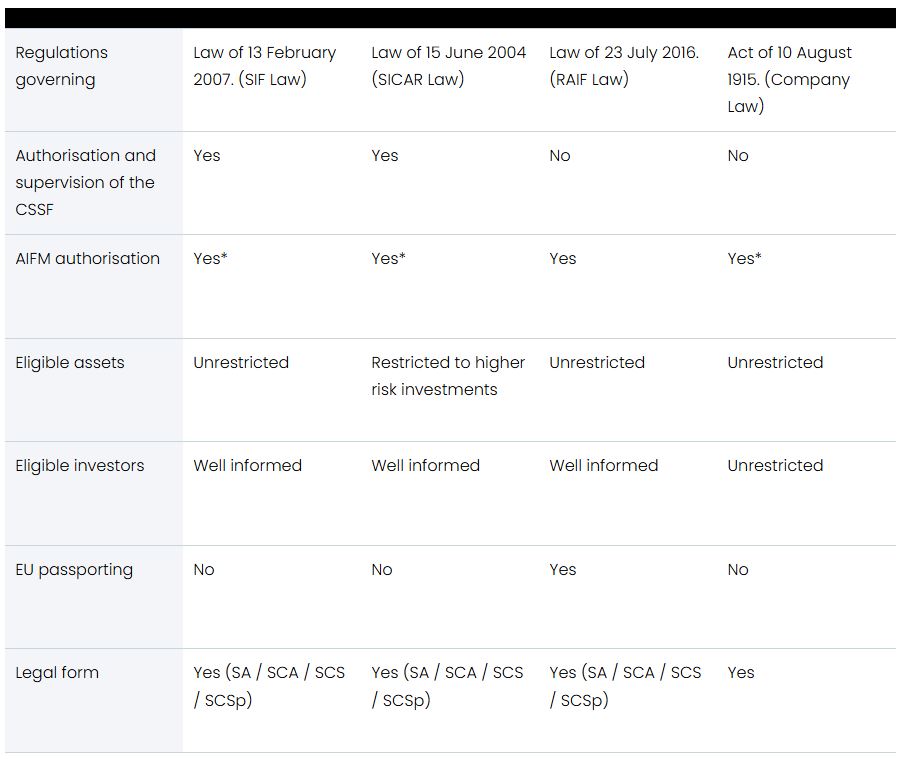
Investment funds in Luxembourg are subject to various pieces of legislation that define their structure, licensing requirements and level of regulatory oversight. The key regulations are:
Luxembourg investment funds benefit from a number of tax advantages that provide a significant incentive for investors. First of all, all investment funds in Luxembourg are exempt from VAT on management services, which reduces operating costs. In addition, these funds are not subject to capital or withholding taxes, which increases their attractiveness in international investment structures.
Investment funds in Luxembourg may be subject to a subscription tax, the basic rate of which is 0.05% of the net asset value. However, there are more favourable reduced rates applicable to selected categories of funds:
It is worth noting that SICAR funds and RAIF funds investing in risk assets are completely exempt from subscription tax, which is particularly attractive to venture capital and private equity investors.
SIFs, UCITS funds and selected SICAR and RAIF funds can benefit from an exemption from capital gains tax if the gains are derived from the sale of securities linked to risky assets. This exemption is intended to facilitate the reinvestment of funds and enhance returns for investors operating in high-risk markets.
Thanks to these exemptions and preferential rates, Luxembourg remains one of the most tax-friendly jurisdictions for investment funds in Europe, offering favourable conditions for both regulated and unregulated funds.
The RAIF is an investment fund structure that combines the features of a SIF (Specialised Investment Fund) and a SICAR (Société d’Investissement en Capital à Risque), but does not require authorisation or supervision by the Financial Sector Supervision Commission (CSSF). It is designed for well-informed investors who are able to understand and accept investme
The RAIF is subject to a subscription tax of 0.01% of its net asset value, but there are exceptions – the following. RAIFs investing exclusively in high-risk assets can choose to be taxed under SICAR-specific rules, which means a complete exemption from subscription tax. This exemption is particularly beneficial for venture capital and private equity funds where a high level of risk is part of the investment strategy.
The RAIF also benefits from an exemption from capital gains tax for income generated from the sale of risky assets. In practice, this means that gains from the sale of such assets are exempt from taxation, which favours investors who prefer a capital growth strategy.
An SCSp is a special limited partnership which, unlike a classic limited partnership (SCS), does not have legal personality. The SCSp is an extremely flexible structure, based on a contract between the partners, which offers a wide range of possibilities for shaping the terms and conditions of the cooperation and for profit sharing. Thanks to its flexibility and the lack of a requirement for authorisation by the CSSF, the SCSp is a popular choice for private equity and venture capital funds that value a simplified regulatory framework.
The SCSp is treated as a tax transparent entity, meaning that it does not pay tax on income at the company level. Instead, income is taxed directly to the shareholders, depending on their tax residence. This structure is advantageous for international investors who can take advantage of Luxembourg’s network of double taxation treaties. This allows profits to be effectively allocated to lower-tax jurisdictions.
As an unregulated investment fund structure, the SCSp is also exempt from subscription tax and capital tax. This makes it one of the most tax-efficient structures available in Luxembourg, which attracts investors looking for a minimum tax burden with high operational flexibility.
Discover more about Fundequate:
The process of setting up an investment fund in Luxembourg requires a well-thought-out strategy and the fulfilment of certain formal steps. The key steps are outlined below:
With the help of the right professionals and the right legal structure, the establishment of an investment fund in Luxembourg can proceed smoothly, enabling a quick start-up and efficient investment in the European and global markets.
Investment funds in Luxembourg offer a wide range of opportunities, supported by flexible regulation, attractive tax advantages and a reputation as a stable and reliable jurisdiction.
If you are considering placing your capital in Luxembourg’s prestigious investment environment, contact Fundequate. Our team will provide support at every stage of the process, including fund structuring, registration and full administrative and accounting services.
Fundequate Sàrl is a company registered and domiciled in Luxembourg. We provide innovative solutions to simplify fund structuring, administration, and investor onboarding, ensuring compliance, transparency, and efficiency for fund managers and investors.


