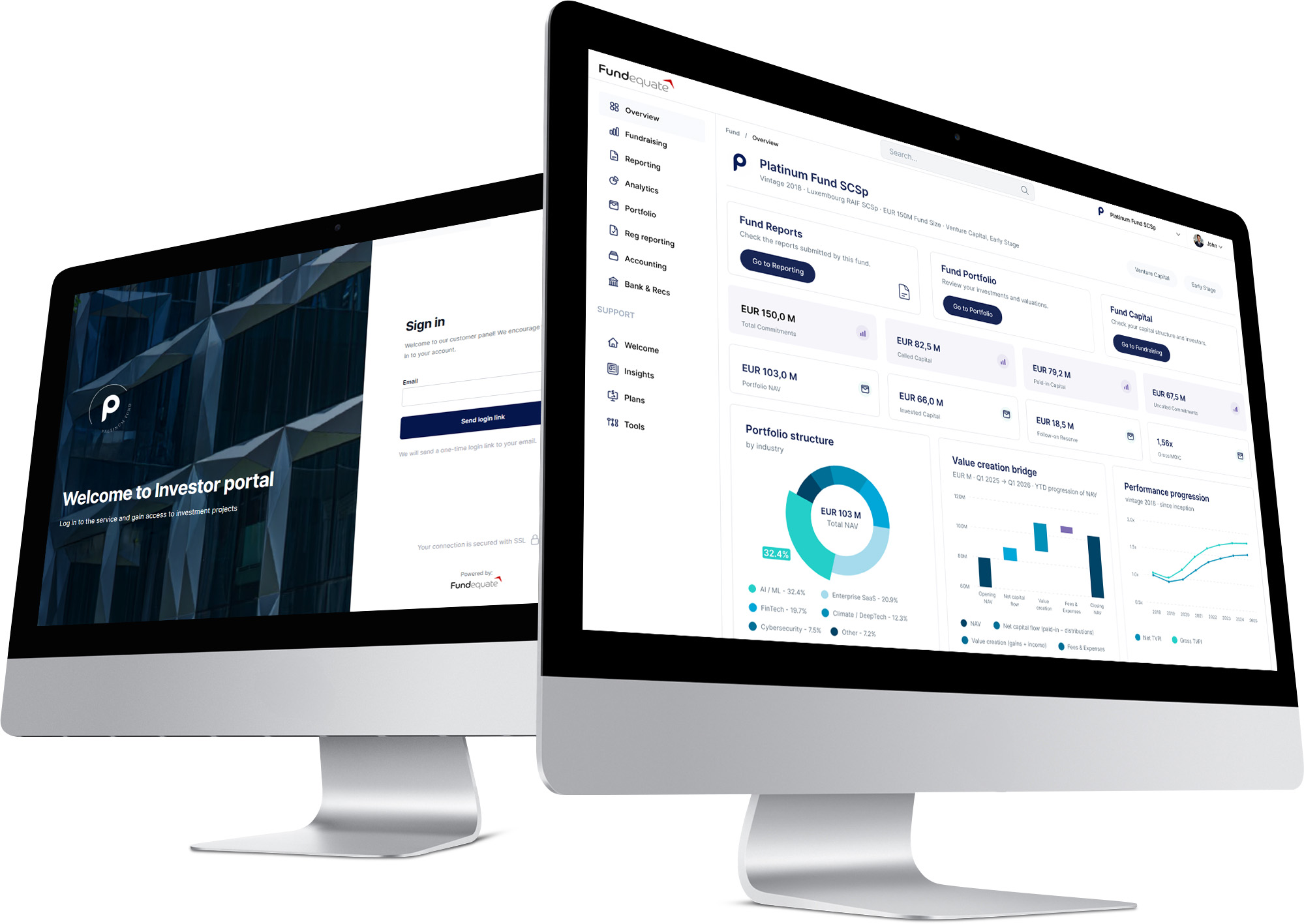
One portal for capital calls, statements, documents and live portfolio performance. Sign subscription documents digitally, complete KYC once, and track every commitment, drawdown and distribution across all your funds in a single place. Reporting packs and tax documents arrive in the same portal, so nothing depends on finding the right email attachment.

A capital call arrives as a PDF on a Tuesday. The quarterly statement comes from a different address six weeks after quarter end, in a layout that changed since last time. The side letter is somewhere in a thread from two years ago, and the annual tax document turns up after your accountant has already asked twice.
None of it is anyone's fault — it is what happens when a position is communicated by email instead of held in a record. The portal does not change your terms or your relationship with the manager. It changes where the information lives.

Subscription documents completed and signed digitally, and identification done once: identity and address evidence, the beneficial owner chain where you invest through a company or a trust, and FATCA and CRS self-certification. When you commit to a second fund on the platform, what has already been verified is reused rather than requested again.
Law of 12 November 2004, as amended; Laws of 24 July 2015 and 18 December 2015. Each fund remains responsible for accepting your subscription.

Every notice with its due date, your share, and what the money is for — investment, management fee or fund expenses — broken out rather than summarised. Payment instructions sit on the notice, the status updates when the fund records your transfer, and a distribution arrives with the same breakdown in reverse.

Your capital account statement each period: commitment, drawn, distributed, unfunded and net asset value, with the movements that produced them. Where the fund reports to the Invest Europe guidelines, the pack arrives in the layout institutional investors already load into their own systems.

The partnership agreement, your subscription documents, any side letter you signed, the annual accounts and the tax documents you need for your own return — filed by fund and kept under version control. When your accountant asks for something from four years ago, it is a folder rather than a search.

Where you hold more than one fund on the platform, the positions roll up: total committed, total drawn, total distributed and current value, by fund and in one currency. Figures update as each fund publishes its valuation — quarterly for most, so this is a current picture rather than a live one.
Committing to a fund is a decision made once. Everything after it is administration: meeting drawdowns on time, understanding statements that arrive quarterly, keeping documents for a holding period that may run ten years, and producing the right paperwork for your own tax return each spring. None of this is difficult. It becomes difficult when the only record of it is a mailbox.
A commitment is a promise to fund when called, usually on ten business days' notice, and the consequences of missing one are set out in the partnership agreement rather than in law. Default provisions typically run from interest on the late amount through to forfeiture of part of the interest already paid in. Knowing what is outstanding and when the next call is plausible is not a convenience; for an investor holding several funds it is the core of the position.
Five figures carry most of the meaning: commitment, paid-in, distributed, unfunded and net asset value. The relationships between them answer the questions that matter — how much of your money is actually at work, how much you still owe, and what the manager currently says it is worth. Where a fund reports to the Invest Europe Investor Reporting Guidelines, those figures appear in a consistent layout from one fund to the next, which is precisely why institutional investors ask for it.
Private holdings are valued on a methodology — commonly the International Private Equity and Venture Capital Valuation Guidelines — at a defined date, approved by the manager and reviewed by the auditor once a year. Between those dates the number does not move, however the market does. A portal can show your position promptly after each valuation is approved; it cannot show a live price for something that does not trade.
Every fund you subscribe to has its own obligation to identify and verify you under the Law of 12 November 2004 and CSSF Regulation 12-02, and that obligation does not transfer between funds. What can be reduced is the duplication: where the documents have already been collected and verified on the platform, a second subscription draws on them instead of starting with a blank form — and the evidence is retained for the period the legislation requires rather than scattered across providers.
If your fund has invited you onto the platform and you would rather talk to someone before signing in, we are happy to walk through what it holds, who can see it and what we do with your data.

Fundequate Sàrl is a company registered and domiciled in Luxembourg. We provide innovative solutions to simplify fund structuring, administration, and investor onboarding, ensuring compliance, transparency, and efficiency for fund managers and investors.


