

Before moving on to the characteristics of Luxembourg investment funds, let us discuss what they are, how they work and their function.
Investment funds act as financial vehicles in which funds from multiple investors are entrusted to professional managers for investment. The accumulated capital can be invested in a variety of assets but always in accordance with an established investment strategy and policy.
There are a number of types of investment funds on the market, each with specific investment objectives, strategies, level of risk taken, complexity and costs of operation. Through them, investors can access different markets and asset classes, benefit from professional management and diversify their portfolios.
Investment funds play an important role in building efficient investment portfolios, supporting the growth of businesses and providing investors with access to a variety of assets and markets.
An Alternative Investment Fund (AIF) operating under the Alternative Investment Fund Managers Directive (AIFMD) in Europe is a type of investment fund that does not fall under the UCITS (Undertakings for Collective Investment in Transferable Securities) directive and typically invests in non-traditional or alternative assets such as real estate, private equity, venture capital.
AIFMD is a European Union directive that regulates the management of alternative investment funds and the activities of managers of such funds. The directive introduces standards for registration, operations, supervision and cross-border marketing for alternative investment fund managers in Europe. Operating under the AIFMD, alternative investment funds can conduct their activities within the EU single market, and are subject to certain regulatory and supervisory requirements.
Venture capital (VC) funds are a type of investment funds that invest their money in companies operating in the new technology and innovative ventures sector.
The main goal of VC funds is to support the growth and expansion of startups that show strong growth potential, but need financial support to develop their products, expand their business reach or enter new markets. VC funds typically invest in companies at the founding or early stage of development, when the company is relatively small and the risks involved are high. In exchange for capital, VC funds often acquire a stake in the company and actively participate in management or provide business support to support the long-term success and growth of the company.
Luxembourg has been an attractive hub for the financial and investment industry for years. So it’s not surprising that many investors looking for new opportunities choose to relocate or open a fund in Luxembourg. However, before taking such steps, it is worthwhile to familiarize yourself with the opportunities or types of funds that are ASI’s counterparts in Luxembourg.
The history of the development of Luxembourg funds dates back to the 1960s. A key moment was the introduction of the Law on Investment Funds in 1988, which greatly simplified the registration and operation of these funds. In the 1990s and early 2000s, Luxembourg became one of the world’s major investment fund registration sites, attracting both European and international funds. Liberal legislation, political and economic stability and favorable tax conditions have attracted a significant number of investment companies and investors.
Today, Luxembourg funds enjoy wide recognition and are widely used by investors from various sectors and regions. Their flexibility, reputation and wide range of products offered keep Luxembourg at the forefront of global financial centers.
Here are some reasons why Luxembourg funds are a unique and attractive investment option.
The above factors make Luxembourg a very attractive place for alternative fund registration and domiciliation.
The success of Luxembourg’s investment funds lies in both the flexible regulations and the types of vehicles available that correspond to AIFs. Crucial to the rapid development of the investment fund industry in Luxembourg has been the rapid adaptation of the UCITS and AIFMD directives into national regulations.
UCITS and AIFMD are regulatory frameworks introduced in the European Union to ensure high standards of investor protection, suitable for retail and professional investors, respectively. UCITS are open-ended funds that invest in securities, such as stocks and bonds, which are subject to the EU regulatory regime. UCITS-compliant investment funds benefit from a “passport,” which allows them to market freely throughout the EU.
Investments in real estate, private equity, venture capital, hedge funds and debt funds fall outside the scope of UCITS, but are subject to the AIFMD, which regulates managers of such investment funds that are not UCITS (i.e., alternative investment funds, or AIFs). Authorized AIF managers benefit from a “passport” that allows them to market to professional investors through the EU.
Luxembourg was the first European Union member state to adapt the UCITS Directive into its legal system, and one of the first to introduce the AIFMD. These early steps were crucial to the success of Luxembourg’s investment fund industry, consolidating its position in the European market.
Luxembourg offers a large selection of vehicle types understood as a contractual form for alternative investment funds, including unregulated and regulated funds. Each has its own advantages depending on the type of assets, capital or strategy of the fund in question.
Unregulated funds:
Regulated funds:
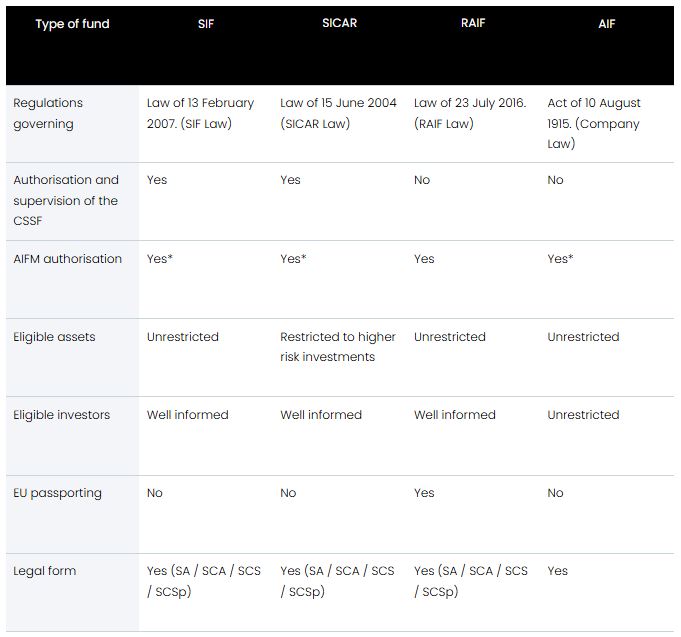
These various forms of investment funds allow investors to tailor the fund structure to their specific needs and goals, contributing to Luxembourg’s attractiveness as a financial center.
Luxembourg funds often enjoy favorable tax conditions, both for the fund itself and for its investors. These funds are usually exempt from taxation on capital gains and income generated in Luxembourg.
Capital gains of investors in Luxembourg funds may be subject to capital gains tax in their countries of tax residence according to local tax laws. Luxembourg has a number of double taxation treaties with individual countries, including Poland.
As with capital gains, the taxation of dividends earned by investors in Luxembourg funds may be governed by tax laws in the investor’s country.
The regulation and supervision of Luxembourg funds is carried out by the Commission de Surveillance du Secteur Financier (CSSF), the Luxembourg supervisory authority. The CSSF plays a key role in ensuring the stability of the financial market in Luxembourg, as well as protecting the interests of investors.
Here are the main functions and tasks of the CSSF in regulating and supervising Luxembourg funds:
Summary
Luxembourg investment funds offer investors numerous advantages, including flexible regulations, favorable tax conditions and access to diverse markets. Compared to Polish alternative investment companies, Luxembourg funds can be an attractive option due to their stability and reputation. Investors can benefit from professional management and portfolio diversification opportunities.
Could investment funds from Luxembourg be the answer to your investment needs and is it worth considering moving some of your capital to this prestigious jurisdiction? If you are considering setting up or moving your fund to Luxembourg – contact Fundequate.
Read more about: Alternative investment fund types and structures in Luxembourg

Fundequate Sàrl is a company registered and domiciled in Luxembourg. We provide innovative solutions to simplify fund structuring, administration, and investor onboarding, ensuring compliance, transparency, and efficiency for fund managers and investors.


