

A deal-by-deal SPV (special purpose vehicle) is an investment vehicle established for a single transaction. In Luxembourg, it is often structured as an SCSp, a special limited partnership without separate legal personality. It serves one target company, one pool of investors, one entry and, in the base case, one exit. It solves three problems at once. The target company gets one line on its cap table instead of twenty direct shareholders. The investors get a defined contractual position: their commitment, their share of proceeds, their information rights. And the person organising the deal (a syndicate lead, an emerging manager, a family office) gets a container for the economics, typically a carried interest, without raising a blind-pool fund.
It is worth being precise about what the vehicle is not:
Three structural reasons, before any marketing one:
The SCSp is governed by Articles 320-1 and following of the Law of 10 August 1915. The features that matter for a deal-by-deal structure are set out below; the form itself, including its use for club deals and feeder vehicles, is covered in more depth in the SCSp guide.
The SCSp is constituted by a limited partnership agreement (LPA) signed privately: no notarial deed, no minimum capital, no auditor's valuation of contributions. Contributions may be in cash, in kind or in industry, and may be drawn over time against commitments. Only an extract of the LPA is filed with the Luxembourg Trade and Companies Register (RCS): the name, the object, the registered office, the general partner and the managers. Limited partners are not named in the public file, and the LPA itself is not published, so commercial terms, the waterfall and the carry stay private. This is confidentiality, not anonymity: beneficial owners are registered in the RBE, and every investor is identified under the AML/CFT rules.
Unlike its twin, the SCS (common limited partnership), the SCSp has no legal personality separate from its partners. It nevertheless has its own estate: its assets answer for its liabilities, are available to its creditors, and the partnership can hold, contract and sue through its general partner. The absence of personality is one of the arguments used for its tax transparency and makes the vehicle look familiar to investors used to English or Delaware limited partnerships.
Partnership interests are issued in registered form or booked through capital accounts, as the LPA provides. The partnership maintains a register of partners; transfers are governed by the LPA, which in a deal-by-deal vehicle typically means GP consent plus, sometimes, a right of first refusal. The beneficial owners of the SCSp must be registered in the RBE (Registre des bénéficiaires effectifs) under the Law of 13 January 2019.
Article 1(39) of the Law of 12 July 2013 defines an alternative investment fund as a collective investment undertaking which raises capital from a number of investors, with a view to investing it in accordance with a defined investment policy for the benefit of those investors, and which does not require authorisation under the UCITS regime. The ESMA guidelines on key concepts of the AIFMD (ESMA/2013/611) apply this test to what the vehicle actually does, not to its name, its size or its marketing materials. The test is worked through element by element in Is a Luxembourg SPV an AIF?
Run the test against a typical deal-by-deal SPV: several outside investors, capital raised for the purpose of the investment, a policy (acquire and hold a defined position in a defined company), management by someone other than the investors collectively. The result, in most configurations, is that the SPV is an AIF. Configurations outside the definition exist (a true joint venture where every investor has day-to-day control, or certain structures investing purely private wealth), but they are exceptions that depend on their facts, not on labelling. The AIF analysis should also distinguish genuine joint ventures and qualifying holding companies from collective investment undertakings. Merely holding shares in a single portfolio company does not, by itself, exclude a vehicle from AIFMD. A vehicle with a single investor is not automatically outside the definition either: under the ESMA guidelines the "number of investors" criterion can be met where the vehicle's binding arrangements do not prevent it from raising capital from more than one investor, or where the sole investor represents capital raised from several underlying investors.
Websites that present Luxembourg SPVs as simply "unregulated" compress this analysis into an assumption. The honest sequence is the reverse: first establish whether the vehicle is an AIF; everything else (the manager, who may be invited, what reporting applies) follows from that answer. Where a structure is genuinely non-AIF, that conclusion should be documented with counsel, because the consequences of being wrong arrive later, at exit or audit, when they are expensive.

Two consequences follow when the SPV is an AIF:
Article 3 of the Law of 12 July 2013 creates the sub-threshold regime most deal-by-deal structures rely on. The manager registers with the CSSF rather than seeking authorisation, provided total assets under management do not exceed:
| Point | Registered (sub-threshold) AIFM | Authorised AIFM |
|---|---|---|
| CSSF status | Registration: identity, AIFs managed, AUM, strategies and leverage notified | Full authorisation: capital, substance, risk management, remuneration, depositary per AIF |
| Marketing | No EU passport; national private placement rules only, country by country | EU passport for marketing to professional investors (Arts. 29–32) |
| Reporting | Annual AIFMD reporting under Art. 3(3)(d) AIFMD, Regulation 231/2013 and the ESMA reporting framework; AUM monitored on an ongoing basis | Full AIFMD reporting (Annex IV), frequency by AUM |
| Depositary | Not required by the AIFM Law for the unregulated SCSp | Generally required per AIF (Art. 21 AIFMD), subject to limited exemptions |
| On breach of threshold | Notify the CSSF without delay, including a temporary excess; if the excess is more than temporary, apply for authorisation within 30 calendar days | n/a |
| Product regimes available | Unregulated AIFs (including SCSps), as well as certain CSSF-authorised funds such as SIFs, SICARs and Part II UCIs, subject to product-specific requirements. RAIFs require an authorised AIFM. | Unregulated AIFs, RAIFs and CSSF-authorised products |
The detail that platforms and leads most often miss: the thresholds aggregate across every AIF the same manager runs, leverage included and derivatives converted to exposure. AUM calculations must also consider AIF portfolios managed indirectly through entities linked by common management, control or substantial ownership, where the AIFM effectively manages those portfolios (Article 3(2) AIFMD). The relevant relationships and actual decision-making powers must be assessed case by case; common ownership alone does not automatically determine aggregation, and setting up additional management companies does not by itself create separate threshold capacity. Each new SPV consumes shared headroom. A manager hosting many deal-by-deal vehicles must track the running total continuously and refuse new vehicles before the limit is reached, because once the excess is more than temporary, the 30-day clock to apply for full authorisation starts, and an authorisation is not assembled in 30 days. A registered AIFM may also opt in to full authorisation at any time, which is the deliberate growth path for a manager whose strategies outgrow the regime. A registered AIFM is not an authorised AIFM in miniature: the CSSF exercises limited supervision over registered AIFMs under specific provisions of the 2013 Law, alongside AML/CFT supervision, and the organisational requirements that apply to authorised AIFMs do not extend to registered AIFMs automatically. The regime in full, from the registration file to the ongoing obligations, is described in Registered AIFM in Luxembourg.

One dating point. Luxembourg transposed AIFMD II (Directive (EU) 2024/927) through the Law of 3 March 2026, with most changes applying from 16 April 2026: delegation, liquidity management tools, loan-originating funds. The amendments primarily concern authorised AIFMs and specific strategies, but any structuring and compliance assessment should be run against the AIFM Law as amended in 2026.
Article 1(9) of the 2013 Law defines marketing as a direct or indirect offering or placement of units or shares of an AIF, at the initiative of the AIFM or on its behalf, to investors domiciled in the EU. Per the CSSF FAQ on the 2013 Law (version 24, 20 May 2025), marketing takes place when the AIF, the AIFM or an intermediary on their behalf actively makes units available for firm purchase; the test is whether the material can be used to subscribe or commit.
Applied to a deal-by-deal SPV under a registered AIFM:
The investor categories, the country-by-country logic, reverse-solicitation evidence and pre-marketing are covered in detail in Who Can You Invite to a Luxembourg SPV?
A standard deal-by-deal structure has four building blocks. Two of them, the GP and the AIFM, are distinct roles even when one group holds both: the GP's mandate is corporate (operating and representing the partnership under the 1915 Law and the LPA), the AIFM's mandate is regulatory (portfolio and risk management under the AIFM Law). GP status alone confers no right to act as AIFM.

Carried interest in a deal-by-deal vehicle is structurally simpler than in a fund: there is no cross-deal netting and the waterfall resolves at a single exit, though the LPA may still provide escrow, clawback or carry-adjustment mechanics. Precisely because it is simple, it should be exact: basis (gain over contributions), rate, any hurdle, and what happens on a partial exit or an in-kind distribution.
The economics also create conflicts of interest that the documentation should name and manage: the lead receives carry, the GP may charge fees, and the AIFM taking the investment decision may belong to the same group. This does not import every rule written for authorised AIFMs; it means clear disclosure in the LPA and offering documents, governance over the investment decision and a real separation of roles.
The SCSp is tax-transparent in Luxembourg: it is not itself subject to corporate income tax or net wealth tax, and distributions by the partnership carry no Luxembourg withholding tax. An unregulated SCSp is likewise outside the subscription tax that applies to SIFs and RAIFs. Luxembourg tax transparency does not eliminate potential withholding taxes at the portfolio-company level or taxation in the investors' jurisdictions. Four qualifications matter in practice:
The constitution itself is the fast part; the calendar is driven by documentation and onboarding. The sequence, with the dependencies made explicit:

From agreed terms to a funded closing, a realistically planned deal-by-deal SPV runs in the order of a few weeks. Promises measured in days assume the LPA is templated, the bank relationship exists and every investor clears KYC at first pass, conditions worth verifying rather than assuming.
Forming an SCSp is inexpensive; running it correctly is where the cost sits. The components to budget for, from formation to wind-up:
| Component | What it covers |
|---|---|
| Structuring and LPA | AIF analysis, LPA and subscription documents prepared with Luxembourg counsel, tax review per investor jurisdiction |
| Formation and filings | RCS extract, RBE registration, registration duty; GP Sàrl incorporation if it does not exist |
| GP and AIFM | GP Sàrl running costs and accounts; the AIFM role, own or hosted, with its CSSF registration and reporting |
| Investor onboarding | AML/KYC files per investor, screening, FATCA/CRS self-certifications |
| Bank account | Account opening and the bank's own KYC on the structure |
| Accounting and reporting | Bookkeeping, capital accounts, partner statements, tax and regulatory filings |
| Exit and liquidation | Waterfall and carry calculation, final accounts, dissolution and deregistration |
A deal-by-deal SPV is quiet after closing, but not silent. The recurring workload:
This operational layer (registers, calls, reconciliations, statements, filings) is the part of a deal-by-deal SPV that is repetitive and has to be correct every time. It is what a fund operations platform takes over; the investment decision, the legal advice and the audit remain where they belong.
One SCSp can legally make several investments. Three practical forces nevertheless push syndicates to one vehicle per deal: liabilities are not segregated between deals inside a single SCSp; the investor group differs deal by deal, which turns the LPA into a matrix of deal-specific classes; and the accounting must track each deal's contributions, costs and proceeds separately anyway.
The legislative direction is worth watching: Bill No. 8814, introduced in the Luxembourg Parliament on 30 July 2026, would insert an Article 28bis into the 2013 Law, allowing SCS/SCSp AIFs to create legally segregated compartments, each a separate pool of assets and liabilities, separately liquidatable, without using a product law. As proposed, the regime applies to AIFs managed by an authorised AIFM, so it would not change the sub-threshold deal-by-deal model; and it is a proposal, not law. If enacted, it would mainly matter to platforms operating at authorised-AIFM scale.
| Dimension | Deal-by-deal SPV (SCSp) | Blind-pool fund |
|---|---|---|
| Scope | One investment, known before commitment | Portfolio built over an investment period |
| Capital | Commitments; typically one call at closing | Commitments drawn over years |
| AIF status | Usually an AIF; same legal test | An AIF |
| Manager | Registered AIFM typical (thresholds permitting) | Registered or authorised, by size and distribution |
| Distribution | National private placement; in this model professional investors and named invitations, with other countries' rules and investor admission assessed separately | Passport if authorised AIFM; otherwise as SPV |
| Carry | Per deal, single-exit waterfall | Fund-level waterfall, netting across deals |
| Term | Tied to one exit | Typically 10 years plus extensions |
| Wind-up | After the exit | At end of fund life |
A vehicle, frequently an SCSp, that pools capital from several investors for one investment, holds it, and is wound up after exit. With outside investors and a defined policy it will generally be an AIF under Article 1(39) of the Law of 12 July 2013 and therefore needs an AIFM.
Private constitution without a notary, no minimum capital, limited partners outside the public file, contractual freedom in the LPA, and tax transparency. Companies (Sàrl, SA) are opaque, carry minimum capital and publication duties, and fit holding layers better than pooling layers.
Not every one. A genuine joint venture may fall outside the AIF definition, but a single investor alone does not take a vehicle outside it: what matters is whether the binding documents prevent raising capital from further investors and whether the sole investor pools underlying investors. The typical deal-by-deal SPV with passive outside investors is an AIF, and the analysis should be documented, not assumed.
A manager whose AUM does not exceed the Article 3 thresholds (EUR 100m with leverage / EUR 500m unleveraged, five-year no-redemption) that registers with the CSSF instead of seeking authorisation. It reports annually under Art. 3(3)(d) AIFMD and the ESMA reporting framework and has no EU marketing passport. The thresholds aggregate across all AIFs it manages, and can extend to portfolios it effectively manages through linked entities.
Under a registered AIFM: professional investors, country by country under national private placement rules; in Luxembourg the CSSF FAQ confines marketing of non-authorised AIFs to professional investors. The gates apply before any document an investor could subscribe on is made available.
No. It applies only where the investor approached the manager first, unsolicited, and the AIFM bears the burden of proof, assessed and documented case by case. Under the harmonised pre-marketing regime for authorised AIFMs, subscriptions within 18 months of the start of pre-marketing are deemed marketing by law.
It is tax-transparent in Luxembourg: investors are generally taxed in their own jurisdictions on their share, depending on residence, local classification and income type. Municipal business tax can arise under Article 14(4) LITL where a corporate GP holds 5% or more, and the reverse-hybrid rules (Article 168quater LITL, Circular 168quater/2) are checked per investor jurisdiction.
Weeks, realistically: the constitution is fast, but the LPA, bank account and investor AML/KYC drive the calendar. Day-count promises assume all three go perfectly.
Legally yes; practically syndicates use one SCSp per deal because liabilities are not segregated and investor groups differ. Bill No. 8814 (2026), proposing segregated compartments for SCS/SCSp AIFs, would as drafted apply to authorised-AIFM structures only and is not yet law.
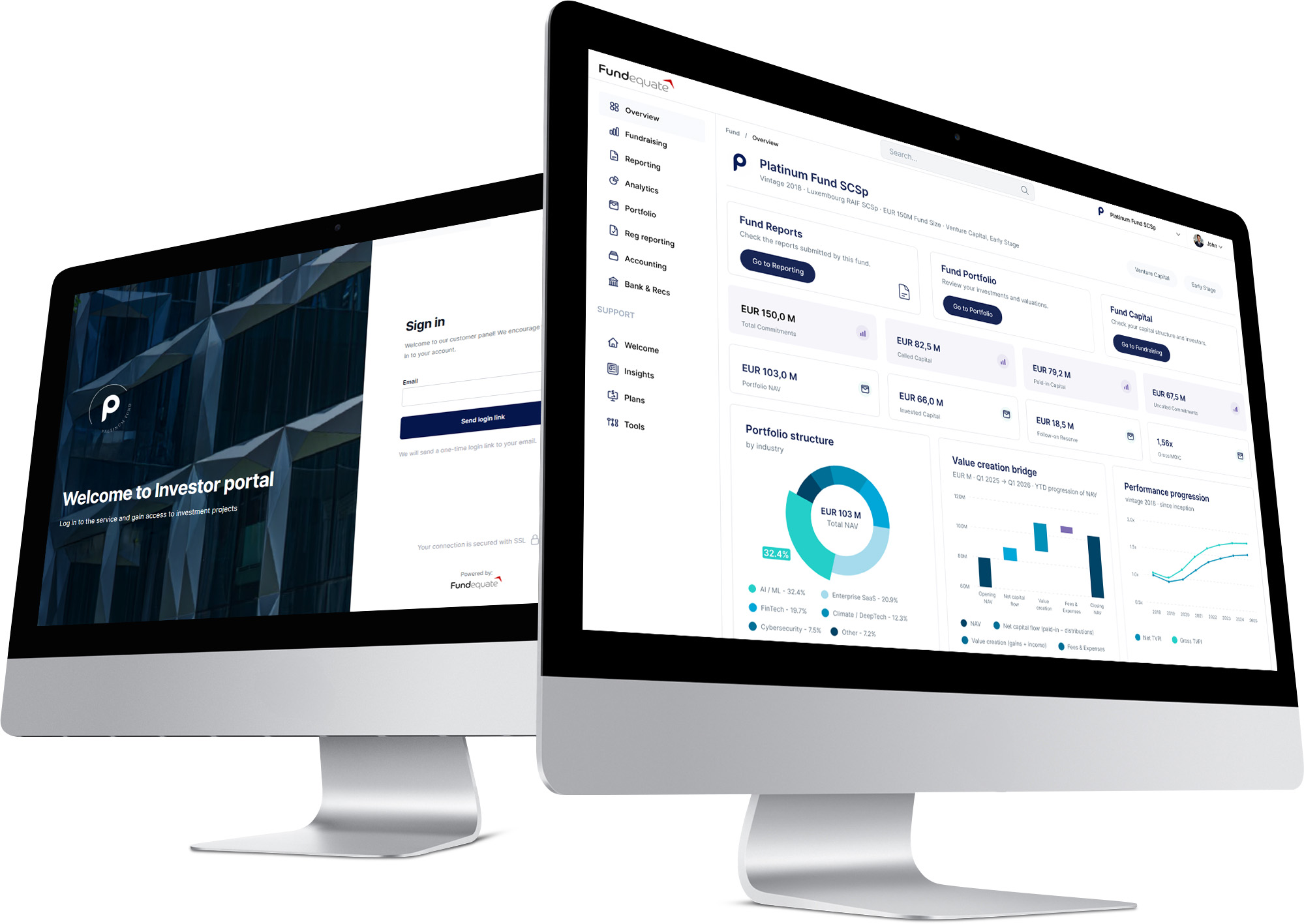
Fundequate Platform implements six record-design rules for Luxembourg AIFs: one investor identifier, dated events, preserved calculations, notice-level reconciliation, four-eyes approval and LPA-controlled configuration.

Fundequate Sàrl is a company registered and domiciled in Luxembourg. We provide innovative solutions to simplify fund structuring, administration, and investor onboarding, ensuring compliance, transparency, and efficiency for fund managers and investors.


