

| Milestone | What it means | What it depends on |
|---|---|---|
| Legal formation | The SCSp is constituted upon execution of its limited partnership agreement (LPA); the RCS registration and the subsequent RBE filing, generally within one month, complete the statutory registration formalities | An existing or newly incorporated general partner; agreed core terms |
| Investor-ready | Offering and subscription documents final, the AIFM appointed, onboarding and eligibility checks running | The AIF analysis, the manager's status, the investor plan per country |
| Transaction-ready | Investors accepted, commitments signed, the bank account open and funded, the company's closing conditions met | Investor KYC clearance, the bank's own onboarding, the target's timetable |
The SCSp is constituted by private agreement under Articles 320-1 and following of the Law of 10 August 1915: no notary, no minimum capital, and the partnership exists from the signature of the LPA. That is why a vehicle on an established platform, with a general partner and an AIFM already in place, can be formed and opened for subscriptions within days. The date that matters to the sponsor, the funded closing, is set by the slowest of three external processes: investors clearing onboarding, the bank opening and operating the account, and the company completing its round. Planning around those three is the real work of a set-up.
Every later step assumes answers to five questions. Each is covered in depth elsewhere in this series; here they are the inputs to the plan.
The set-up is a set of parallel workstreams with a few hard dependencies. The plan below assigns each step to the party that owns it and states what it needs before it can start.
| Step | Owner | Output | Depends on |
|---|---|---|---|
| Structuring and AIF assessment | Sponsor, Luxembourg counsel | Structuring memo: AIF status, AIFM, investor plan, tax posture | Transaction terms |
| General partner | Sponsor, notary | GP Sàrl incorporated, or the platform's existing GP confirmed | GP ownership, EUR 12,000 capital on a blocked account, KYC of the GP's owners |
| LPA and investor documents | Counsel, GP | LPA, subscription agreement, term sheet or offering memorandum | Agreed economics: ticket, costs, carry, closing date |
| Formation | GP | Signed LPA; the SCSp exists | Final LPA and a GP able to sign |
| RCS filing | GP or corporate agent | RCS number and published extract | Signed LPA |
| RBE filing | GP or administrator | Beneficial-owner filing, kept current as investors join | RCS number; beneficial-owner analysis |
| AIFM arrangements | AIFM, counsel | Management agreement; notification of the AIF under Circular CSSF 25/894, for a registered AIFM within 10 working days of starting to manage it | AIF classification; threshold headroom |
| Bank account | GP, bank | Account open with payment controls and signatories | The bank's onboarding of the SCSp, GP and beneficial-owner chain |
| Investor onboarding | AIFM or its delegate | Cleared files: identity, beneficial owners, screening, source of funds where required, FATCA and CRS self-certifications, eligibility | Investor documents; the onboarding procedure |
| Subscriptions and register | GP, administrator | Countersigned subscriptions; register of partners | Cleared onboarding |
| Capital call and funding | GP, administrator | Call notices, reconciled receipts | Open account; accepted commitments |
| Investment and closing | GP, transaction counsel | Closing file: executed transaction documents, payment, share register of the company | Funds received; the company's closing conditions |
Three dependencies decide the calendar. The LPA blocks formation, and therefore the RCS number, which most banks need. The bank account blocks the capital call. Investor onboarding blocks the acceptance of each subscription. Everything else runs in parallel around them, which is why the bank and onboarding processes are started on near-final documents rather than after signature.
Not every document has the same status. Separating what the law requires from what the regulatory set-up and the transaction require avoids both gaps and unnecessary paperwork.
How long each milestone takes depends above all on whether the general partner and the AIFM already exist.
| Milestone | Hosted vehicle (platform GP and AIFM) | Own structure (new GP, own registered AIFM) |
|---|---|---|
| Legal formation | Days: LPA generated from agreed terms, signed, filed | GP incorporation first: blocked capital account, notarial deed, RCS and RBE filings, then the SCSp |
| Investor-ready | In parallel with formation: documents, onboarding links and eligibility checks are opened as soon as terms are fixed | An own registered AIFM adds governance, AML/CFT and CSSF registration workstreams; the timetable depends on the completeness of the submission, the applicable requirements and the CSSF review, with no guaranteed registration timeframe |
| Transaction-ready | Set by investor onboarding, the bank account and the company's closing | The same, plus the bank's onboarding of a new GP and its owners |
Two practical observations. First, the hosted model compresses the first two milestones because the slow, one-off steps, incorporating a GP, registering an AIFM and opening institutional bank relationships, were done once for the platform rather than for each deal. Second, no structure removes the third milestone's dependencies: an investor who cannot evidence source of funds, or a company whose round slips, moves the closing whatever the vehicle. A realistic set-up plan states the expected closing date, the onboarding cut-off for investors and the fallback if an investor is not cleared in time, typically a reduced allocation or admission at a later closing.
Launching a Luxembourg SPV for your next deal?
Fundequate helps sponsors structure, launch and operate Luxembourg SCSp investment vehicles through an integrated platform covering investor onboarding, commitments, capital calls, accounting and investor reporting.
Tax transparency moves the work to the set-up stage. Before the first euro is invested, the following are decided and recorded:
The tax treatment itself is summarised in the tax section of our deal-by-deal SPV guide.
A closing is ready when every item below can be ticked, not when the deal team is ready to sign:
Why the closing file matters later. The documents assembled at closing are the evidence base for the auditor, the bank's periodic reviews, the AIFM's regulatory reporting and, years later, the exit. A closing that is fast but undocumented moves the work to the moment when it is most expensive to do.
Setting up the vehicle is the first stage of its life. From the moment commitments are accepted and the investment is executed, the SCSp needs reliable accounting records, capital-account administration, financial reporting and ongoing compliance, usually for five to ten years. Fundequate combines Luxembourg expert-comptable expertise, specialised SPV operations and a proprietary digital platform, so that these processes run on one set of records.
For an SCSp used in a private equity or venture capital transaction, financial administration goes beyond statutory bookkeeping. It records investor commitments and contributions, the acquisition cost of the investment, fees and operating expenses, valuations, distributions and carried interest allocations, and it translates the allocation rules of the LPA into partner capital accounts. Keeping all of this in one accounting framework from the first closing removes the need to reconstruct information from separate spreadsheets when financial statements, investor reports or tax information are due.
Authorised users access their vehicles' financial information and reports on Fundequate's platform. Depending on the vehicle's arrangements and each user's access rights, this covers accounting records, investor capital accounts, financial statements and investment reports. Sponsors, general partners and investors obtain what they need from the platform instead of relying on periodic email requests and manually assembled reports.
A Luxembourg SPV involves several parties: the sponsor, the general partner, the AIFM where applicable, legal advisers, accountants, the bank and the investors. Fundequate connects the accounting workstream with the digital records of investor onboarding, commitments, capital calls, distributions and reporting. Legal advice remains with Luxembourg counsel, regulated portfolio and risk management with the appointed AIFM, and any statutory audit with the vehicle's auditor.
Fees vary by provider, deal size and number of investors, so a set-up budget is best built from its components, each marked as one-off or recurring and as mandatory, conditional or provider-dependent:
| Component | Timing | Nature | Note |
|---|---|---|---|
| GP share capital | One-off | Mandatory for a new GP Sàrl | EUR 12,000 minimum, paid in and remaining the GP's equity; none if an existing GP is used |
| Notary and GP incorporation | One-off | Mandatory for a new GP | Not incurred on a hosted vehicle |
| LPA and investor documents | One-off | Mandatory | Templated documents cost less than bespoke drafting |
| RCS and RBE filings | One-off, then on changes | Mandatory | Official filing fees |
| AIFM | Recurring | Mandatory where the vehicle is an AIF | Hosted fee, or the cost of running an own registered AIFM |
| Investor onboarding | Per investor | Mandatory | The main variable: the same file is needed for a small ticket as for a large one |
| Bank account | One-off and recurring | Mandatory in practice | Account and transaction fees per bank |
| Accounting, tax returns, investor reporting | Recurring | Mandatory | Bookkeeping, capital accounts, tax filings and partner statements each year |
| Transaction counsel | One-off | Conditional | Depends on the complexity of the investment documents |
| Audit | Recurring | Conditional | Where the LPA, investors or a product regime require it |
| Exit and liquidation | One-off | Mandatory | Waterfall, final accounts, deregistration from the RCS and the RBE |
Two numbers tell an investor what the cost model means for them: the share of each commitment that reaches the company, and the expected annual cost charged to the vehicle until exit. Both belong in the term sheet.
Yes. The SCSp is constituted by a private limited partnership agreement under the Law of 10 August 1915, with no notarial deed and no minimum capital. A notary is needed only to incorporate a new general partner in the form of a Sàrl.
On the signature of the limited partnership agreement. The extract is then filed with the RCS and the beneficial owners with the RBE; most banks require the RCS number before they open the account.
No. One GP Sàrl can act as general partner of several partnerships, which is how platforms and repeat sponsors operate. A dedicated GP per vehicle is chosen where liability, governance or the sponsor's investors require it.
A subscription agreement, or an accession to the LPA, with the commitment, eligibility and tax representations, FATCA and CRS self-certification and data-protection information, together with the identification and beneficial-ownership documents required for onboarding.
The bank runs its own onboarding of the SCSp, its GP and the beneficial-owner chain, usually only once the RCS number exists, and the capital call cannot be made until the account operates. Starting the bank file on near-final documents is the most effective way to shorten a set-up.
The SCSp is a commercial company by legal form, but passively holding investments for its partners does not by itself require a business permit. A GP whose object is limited to acting as general partner is generally analysed the same way, while an entity selling services to third parties checks whether it needs a permit under the Law of 2 September 2011 or a financial-sector status, looking at both its corporate object and the activities it actually performs.
White-label business is the management of a fund at the initiative of a third party, for example a fund using the initiator's name. Under Article 13(2a) of the Law of 12 July 2013 the IFM explains to the CSSF how it complies and manages conflicts, using the form published on 8 October 2026 when it starts such business for the first time. Its application to a specific registered AIFM is a separate analysis.
A formed and registered SCSp, an appointed AIFM with the CSSF notification calendar in hand, an operational bank account, accepted investors with countersigned subscriptions, and the tax and reporting set-up recorded so that receipts can be reconciled and statements issued from the books.
Fundequate Platform implements six record-design rules for Luxembourg AIFs: one investor identifier, dated events, preserved calculations, notice-level reconciliation, four-eyes approval and LPA-controlled configuration.
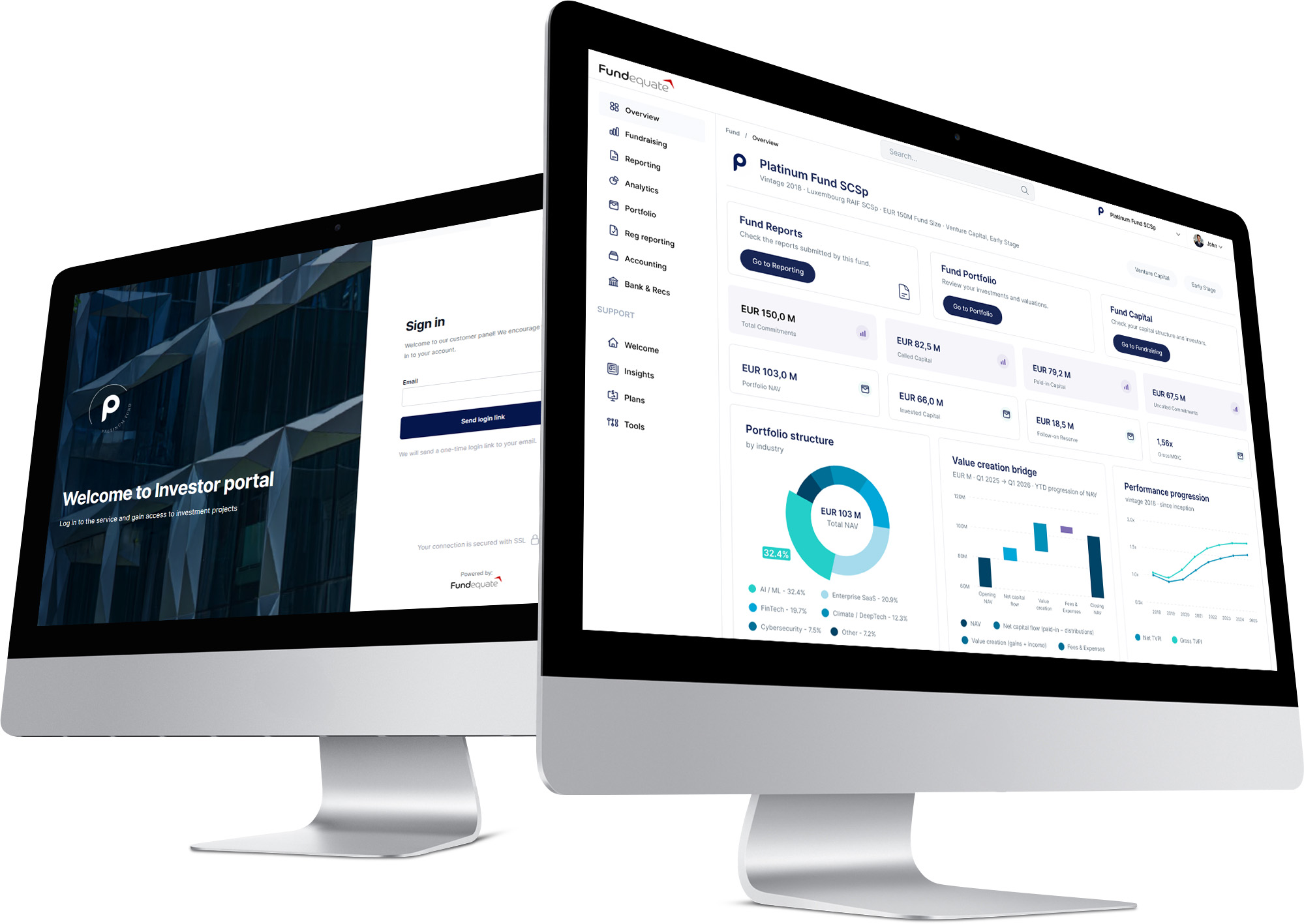
Investor onboarding, commitments and closings, capital calls, distributions, capital accounts and waterfall — with an LP portal, full audit trail and Invest Europe-aligned reporting.
Incorporation, RCS and RBE registration, bookkeeping, statutory accounts, VAT and annual filings, registered office and Luxembourg-resident management — the full substance layer for your fund vehicle.

Fundequate Sàrl is a company registered and domiciled in Luxembourg. We provide innovative solutions to simplify fund structuring, administration, and investor onboarding, ensuring compliance, transparency, and efficiency for fund managers and investors.


Fundequate Sarl
2 Rue Siggy vu Letzebuerg
L-1933 Luxembourg
contact@fundequate.com
Tel. +352 661 324 404
