

The special limited partnership has no legal personality (Article 320-1 of the Law of 10 August 1915), and Luxembourg tax law treats it as a pass-through for the taxes levied on income and wealth: under Article 175 LITL the corporate income tax applies to the partners, not to the partnership. Income and gains are determined at the level of the SCSp and allocated to the partners according to the limited partnership agreement (LPA), and each partner is taxed, if at all, under its own rules. The legal form itself is covered in our SCSp guide; the position tax by tax is as follows.
| Tax | Unregulated SCSp | What can change it |
|---|---|---|
| Corporate income tax | Not a taxpayer; income allocated to partners | Reverse hybrid rule, Article 168quater LITL, on the mismatched part of the income |
| Municipal business tax | Not a taxpayer if it carries on no commercial activity | Commercial activity, or a capital company GP holding 5% or more (Article 14(4) LITL) |
| Net wealth tax | Not a taxpayer | Nothing at partnership level; corporate partners apply their own rules |
| Withholding tax on distributions | None; a distribution is an allocation, not a dividend | Withholding on income received from portfolio companies remains possible at source |
| Subscription tax | Not applicable | Applies at 0.01% if the SCSp is set up as a SIF or a RAIF, subject to product exemptions; a RAIF under the SICAR tax regime is outside it |
| VAT | Management of an AIF can be exempt (Article 44(1)(d) VAT Law) | No exemption for a non-AIF; its VAT status and the place-of-supply rules decide on registration |
| Capital duty | None on contributions | Not applicable since its abolition in 2009 |
Three consequences follow. First, transparency is a Luxembourg characterisation; the investor's own country applies its own classification, and the vehicle can be opaque there. Second, transparency does not neutralise taxes levied below the vehicle: withholding tax on dividends or interest paid by portfolio companies, and the investor's ability to recover it under a treaty, depend on how the source country treats a payment to a partnership and to the investors behind it. Third, the general partner is not transparent. The GP Sàrl is an ordinary taxable company subject to corporate income tax, municipal business tax and net wealth tax, including the minimum net wealth tax, and it files its own returns and annual accounts.
VAT deserves a separate remark because it is often confused with the AIF question. Since the AIFM Law of 12 July 2013, the exemption for the management of investment funds in Article 44(1)(d) of the Law of 12 February 1979 on VAT extends to AIFs. Whether an SCSp is an AIF, assessed under the criteria explained in our AIF test guide, therefore matters for the cost of running it: portfolio and risk management of an AIF can be invoiced without VAT, while services supplied to a non-AIF SCSp do not qualify for the AIF management exemption merely by reason of the vehicle's legal form; their VAT treatment depends on the nature of the services, other applicable exemptions, the place-of-supply rules and the VAT status of the recipient. The exemption follows the nature of each service rather than the label on the invoice: administrative services can qualify where they are specific and essential to the management of the fund, while legal, audit and many transaction services fall outside it. For a non-AIF SCSp, its status as a taxable person and the place-of-supply rules then determine whether it must register, for instance to self-account for services received from abroad.
Apart from corporate income tax on reverse hybrid income (section 4), municipal business tax (MBT) is the Luxembourg income tax that can apply to the SCSp as such. Under Article 14 LITL and the MBT Law, a partnership is within MBT when it carries on a commercial activity, or when it is deemed to do so. Circular L.I.R. n° 14/4 of 9 January 2015 explains both limbs.
An SCS or SCSp that qualifies as an AIF under the Law of 12 July 2013 is deemed not to carry on a commercial activity within the meaning of Article 14, n° 1 LITL, because an AIF by definition invests according to a defined investment policy. For a non-AIF partnership the question is factual: managing a portfolio within the ordinary bounds of private wealth management is not commercial, while exploiting the substance of the portfolio through a turnover of substantial assets (Umschichtung) can be. The circular, drawing on case law, points to the number of acquisitions, quick resales and short holding periods as indicators, and rejects schematic tests: neither the size of the holdings nor the sale of some assets within a relatively short period is decisive on its own. A buy-and-hold SPV that acquires one company and exits years later sits comfortably on the asset-management side.
Under Article 14(4) LITL, a limited partnership (SCS or SCSp) is deemed to carry on a commercial activity in full where a general partner that is a capital company (such as an SA, Sàrl or SCA) holds at least 5% of the partnership interests. This is the Luxembourg version of the German Gepräge doctrine. The circular is explicit that the rule applies independently of the activity analysis, so AIF status does not neutralise it: an AIF partnership whose corporate GP holds 5% is within MBT on its whole profit, and its partners' share is commercial income. The SICAR is the statutory exception: Article 34 of the SICAR Law disapplies Article 14(4).
The law does not define how the 5% is measured, and the circular refers only to "parts d'intérêts". The disciplined approach is therefore to keep the corporate GP below 5% on every measure that could be argued:
The rule only bites on a GP that is a capital company. Some structures use a partnership or an individual as unlimited partner for that reason, but the corporate GP Sàrl remains the market standard because it ring-fences unlimited liability, and the 5% discipline is the price of that choice. The structural roles of GP, AIFM and carry vehicle are set out in our deal-by-deal SPV guide.
Consequence of a breach. If the deeming limb applies, the SCSp computes a commercial profit subject to MBT (at around 6.75% in Luxembourg City) and files form 300. The tax administration treats all partners, resident and non-resident, as realising Luxembourg commercial profit; for a non-resident the final position then depends on the applicable double tax treaty. The SCSp remains transparent for corporate income tax, but there is no partial taint: the rule switches the whole partnership.
Because the SCSp is transparent, the tax analysis runs investor by investor and depends on three variables: the investor's residence, how that jurisdiction classifies the SCSp, and the character of the income allocated.
A non-resident partner is generally not subject to Luxembourg income tax on its share of income and gains derived through a non-commercial, tax-transparent SCSp. Luxembourg taxing rights arise only where Article 156 LITL gives them, and the cases most relevant to investment partnerships are the following:
The list is not exhaustive; the final position of each investor is assessed under Luxembourg domestic law and the applicable double tax treaty.
Outside these cases, the investor's home jurisdiction decides. If it treats the SCSp as transparent, the investor reports its share of the underlying dividends, interest and gains as they arise. If it treats the SCSp as opaque, the investor is typically taxed only on distributions or on disposal of its partnership interest, often under its domestic rules for foreign investment funds or companies. That difference is the root of the reverse hybrid problem in section 4.
A resident individual is taxed on the allocated income according to its character: dividends and interest under the rules on income from capital, gains under the rules on private gains, which tax gains realised within six months of acquisition as speculative and gains on substantial participations above 10% at reduced rates. If the partnership is commercial, the share is business income instead. A resident company includes its share in its taxable base and applies its own regime, which can include the participation exemption where its conditions are met on a look-through basis; net wealth tax on its share of the partnership's assets follows the same logic.
Article 168quater LITL, which transposes the reverse hybrid rule of ATAD 2 and applies from tax year 2022, removes transparency on a defined slice of income. It applies where:
When the conditions are met, the SCSp becomes subject to corporate income tax on that mismatched income only. The rest of its income stays transparent.
The "associated" requirement is what keeps most syndicate vehicles out of scope. Under the ATAD 2 definitions transposed in Article 168ter LITL, investors acting together are aggregated, but an investor in an investment fund holding less than 10% of the fund and entitled to less than 10% of its profits is presumed not to act together with the others. In a widely held syndicate, no investor or group reaches 50%. The rule becomes live in feeders and co-investment vehicles with a dominant limited partner, in family-office vehicles, and where a group of investors coordinates its investment.
Article 168quater excludes collective investment vehicles that are widely held, hold a diversified portfolio of securities and are subject to investor-protection regulation. Circular L.I.R. n° 168quater/2 of 12 August 2025 treats UCIs under the Law of 17 December 2010, SIFs and RAIFs as collective investment vehicles by presumption, and sets out how each criterion is read for other structures, including unregulated AIF partnerships:
A single-asset deal-by-deal SCSp fails the diversification criterion by design, and if its manager is a registered AIFM it also falls outside the investor-protection condition as the Circular describes it. It cannot rely on the exemption and must instead confirm that the substantive conditions are not met. A feeder into a diversified master can, depending on its investor base and its manager, be in a better position. In both cases the analysis is documented before the first closing and reassessed whenever the investor composition or a relevant classification changes.
The carried interest reform (Bill No. 8590, adopted by the Chamber of Deputies on 22 January 2026) rewrote Article 99bis LITL with effect from tax year 2026, and individuals under the transitional regime of Article 213 of the AIFM Law move to the new framework. The regime governs how Luxembourg taxes carry received by Luxembourg tax-resident individuals; non-resident carry holders do not benefit from it merely because the AIF is a Luxembourg SCSp, and their position follows their residence state's rules, any Luxembourg taxing right and the applicable double tax treaty. It distinguishes two forms:
Eligibility is functional, not a matter of title: the regime covers individuals performing investment, risk or portfolio management functions as employees, managers, directors or partners of the AIFM, management company or fund, and those contributing to the management of the AIF under an advisory or service agreement, directly or through intermediary entities. Individuals performing purely administrative functions are excluded. The previous condition that investors first recover their full investment has been removed, which matters for deal-by-deal structures where carry is paid per transaction.
Two illustrations. A Luxembourg-resident investment professional of the AIFM entitled under an agreement with the fund to a share of its outperformance receives contractual carry, taxed at a quarter of the global rate. The same professional holding a carry participation through a carry SCSp admitted as a limited partner of the fund, realised more than six months after it was acquired, can receive participation-linked carry that is exempt, subject to the Article 100 analysis of his direct and indirect holdings, even though the carry SCSp is transparent and the underlying proceeds are dividends or gains of the fund. Article 99bis covers the qualifying carried interest only: the return on an ordinary co-investment alongside the LPs is taxed under the general rules. Two tax points connect the reform to the SCSp itself. The carry vehicle sits outside the GP, for the 5% reasons in section 2. And the LPA waterfall, the carry vehicle's own agreement and the investor reporting must describe the same economics, because the characterisation of the carry holder's income follows from those documents.
Transparency removes taxes, not paperwork. The recurring obligations of an SCSp are:
Transparency moves the tax computation to the investor, which turns investor reporting into the operational centre of an SCSp. Timetables are set by the fund documents; as market practice, the Invest Europe Investor Reporting Guidelines (2024) describe quarterly reports within 60 days of quarter end and annual accounts within 120 days of year end for funds holding direct investments, with capital accounts reported quarterly. Tax information needs the same discipline, because investors' own filing deadlines depend on it. A complete annual tax pack per partner contains:
Two practical rules keep the pack defensible. Tax allocations are derived from the allocation provisions of the LPA, including the waterfall and any equalisation, and reconciled to the capital account and to cash, so that each partner can see why its taxable income differs from what it received. And the data model is fixed at onboarding: residence, classification, FATCA and CRS status and, where relevant, the investor's own exemptions are collected once, through the subscription process described in our guide to who you can invite, and reused for every period.
Before the first closing, document: the corporate GP's interest below 5% on capital, profit and liquidation entitlements; carry and sponsor commitment held outside the GP; the AIF analysis for MBT and VAT; the reverse hybrid position per investor jurisdiction; the FATCA and CRS classification; the filing position for the partnership tax return; and the content and calendar of the investor tax pack.
The form depends on the income: form 205 for transparent entities earning mainly investment income, which also carries reverse hybrid tax; form 200 for commercial, professional and certain other income; form 300 for commercial income within MBT. An SCSp invited to file form 205 files it even with nothing to report. Form 205 is filed through MyGuichet.lu, forms 200 and 300 by post with an original signature, generally by 31 December of the following year.
Article 14(4) LITL refers to 5% of the partnership interests, and Circular L.I.R. n° 14/4 does not define the metric further. Keep the corporate GP below 5% on capital, share of profits and share of liquidation proceeds, and hold carry and sponsor commitments through a separate limited partner, with each entitlement clearly characterised in the LPA.
It is usually avoided. Whether a profit allocation to a corporate GP counts towards its 5% depends on how the LPA constructs it, and the risk is MBT on the whole partnership. Carry normally sits in a separate carry vehicle admitted as a limited partner; Luxembourg-resident individuals who qualify then fall under the 2026 carried interest regime.
Usually not. Under Circular L.I.R. n° 168quater/2 a single-asset vehicle is not diversified, and for unregulated partnerships the investor-protection condition refers to AIFs of authorised AIFMs, not registered ones. A deal-by-deal SCSp instead confirms that the substantive conditions of Article 168quater are not met, per investor jurisdiction.
Generally not, where the SCSp is non-commercial and transparent. Luxembourg taxing rights can arise from Luxembourg real estate, certain gains on substantial participations in Luxembourg companies, a Luxembourg permanent establishment, or commercial income where the partnership is, or is deemed under Article 14(4) LITL to be, commercial. The final position follows domestic law and the applicable treaty.
Management of an SCSp that is an AIF can be exempt under Article 44(1)(d) of the VAT Law, extended to AIFs in 2013. The test is the nature of each service: administrative services can qualify where specific and essential to fund management. A non-AIF SCSp has no exemption, and its VAT status and the place-of-supply rules decide on registration.
An annual tax pack per partner: income by character with source country and foreign withholding tax, expenses split between deductible and capitalised, acquisition and disposal dates, look-through percentages per portfolio company, and taxable income, capital account and cash distributions shown separately and reconciled, plus jurisdiction-specific data where investors need it.
No, it is transparent for net wealth tax; corporate partners apply their own rules to their share. The GP Sàrl is an ordinary taxable company and pays corporate income tax, MBT and net wealth tax, including the minimum net wealth tax.
Fundequate Platform implements six record-design rules for Luxembourg AIFs: one investor identifier, dated events, preserved calculations, notice-level reconciliation, four-eyes approval and LPA-controlled configuration.
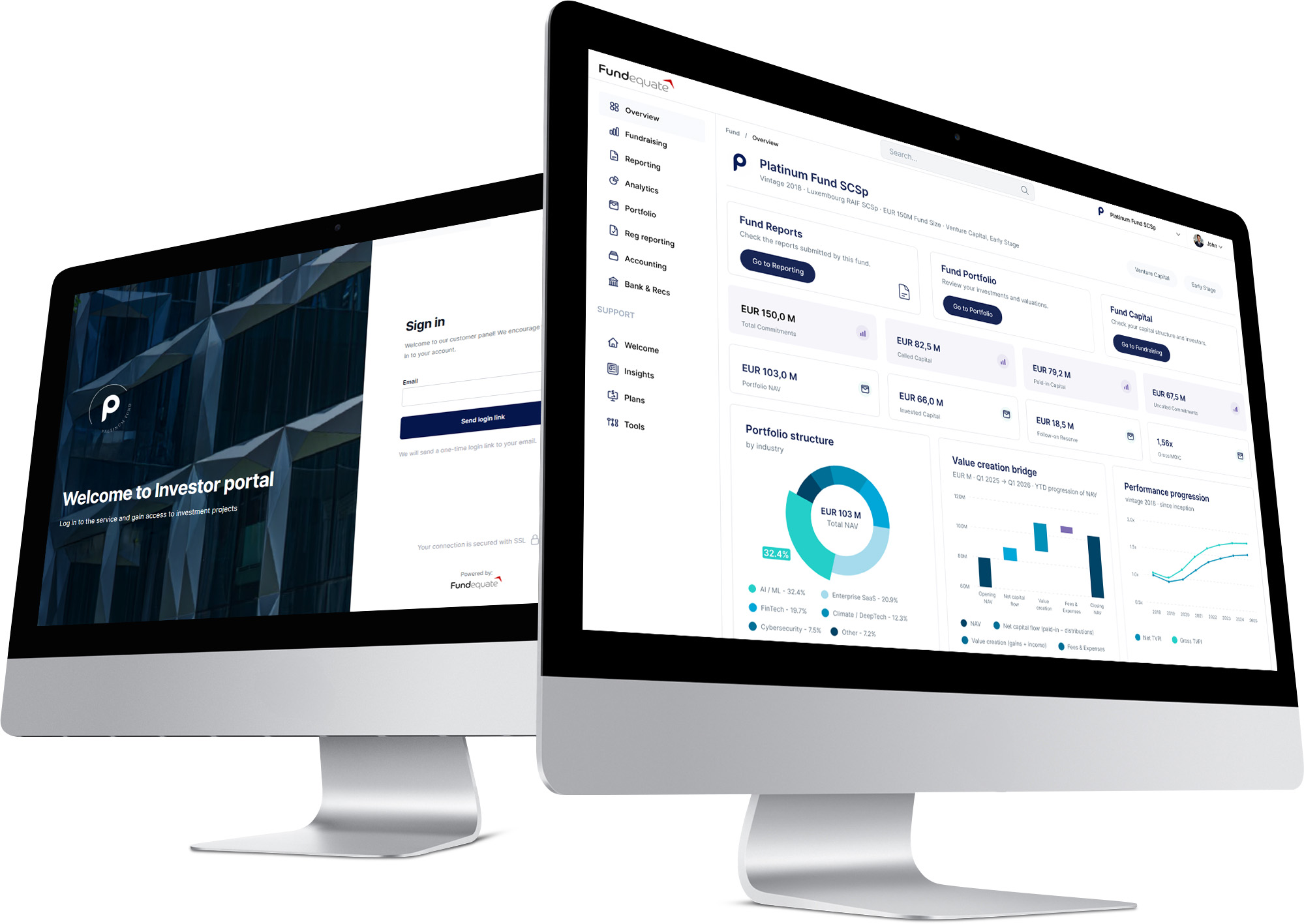
Investor onboarding, commitments and closings, capital calls, distributions, capital accounts and waterfall — with an LP portal, full audit trail and Invest Europe-aligned reporting.
Incorporation, RCS and RBE registration, bookkeeping, statutory accounts, VAT and annual filings, registered office and Luxembourg-resident management — the full substance layer for your fund vehicle.

Fundequate Sàrl is a company registered and domiciled in Luxembourg. We provide innovative solutions to simplify fund structuring, administration, and investor onboarding, ensuring compliance, transparency, and efficiency for fund managers and investors.


Fundequate Sarl
2 Rue Siggy vu Letzebuerg
L-1933 Luxembourg
contact@fundequate.com
Tel. +352 661 324 404
