

A European syndicate run through Luxembourg typically has five parties, and each needs to be named in the documentation:
The most important structural point for the lead: in a typical hosted syndicate, the lead sources and recommends investments, while the appointed AIFM retains responsibility for portfolio and risk management. A lead exercising discretionary investment management functions requires a separate regulatory assessment, including whether a legally compliant delegation arrangement under the AIFM rules, as tightened by AIFMD II, and an appropriate authorisation or registration are available. An advisory agreement alone does not authorise the lead to make investment decisions. The rest of this guide builds on that line.
A lead's income from a syndicate comes from a short list of sources. Each has a different legal character, and the documents should keep them apart:
| Income line | Who pays | Market practice | Point to settle |
|---|---|---|---|
| Carried interest | Co-investors, out of profit at exit | The main and often the only remuneration of the lead | Rate, basis, hurdle, the lead's own ticket, sharing with co-leads (section 3) |
| Deal or management fee | Co-investors, usually deducted from commitments | Many syndicates charge none; where charged, often one-off rather than annual | Whether it remunerates the lead or covers vehicle costs; VAT |
| Advisory fee | The AIFM, under an advisory agreement | Used where the lead acts as adviser to the AIFM | The lead's licensing status and VAT (section 4) |
| Fees or shares from the company | The portfolio company | Finder's fees, advisory shares, board fees | A conflict of interest: prohibit, credit to investors or disclose in full (section 6) |
Benchmarks for these terms come mostly from the US market. Data from one US administrator's book of roughly 1,800 SPVs formed between October 2024 and October 2025 shows a median carry of 15%, with a quarter of vehicles at the traditional 20%; about half charged a management fee, most commonly 2%, and in 80% of those cases for one year only rather than over the life of the vehicle. Comparable European data is not published on the same basis; the figures describe one US platform's client base, weighted towards venture-stage deals, and are a reference point rather than a European norm.
Separately from the lead's remuneration, the vehicle has costs: structuring and documentation, the GP and AIFM, investor onboarding, the bank account, accounting, tax filings and the eventual wind-up. They are either deducted from the capital called, so that less than 100% of each commitment reaches the company, or charged on top of the commitment. Both are legitimate; what matters is that the co-investor sees the investment ratio, the share of its money actually invested, before it signs. A syndicate that quotes a ticket of EUR 25,000 and invests EUR 23,750 of it should say so in the term sheet.
Assume a syndicate with no commitment from the lead and no costs after closing other than those shown. It raises EUR 1,000,000 in commitments. Vehicle costs of EUR 30,000 are deducted, so EUR 970,000 is invested, an investment ratio of 97%. The company is sold and the vehicle receives three times its investment, EUR 2,910,000. The profit over contributions is EUR 1,910,000; a 20% carry with no hurdle is EUR 382,000. Co-investors receive EUR 2,528,000, a net multiple of 2.53x on a deal that returned 3.0x gross. The difference between the deal multiple and the investor multiple is the economic content of the syndicate's terms, and a lead who shows both builds more trust than one who shows only the first.
Carry in a deal-by-deal syndicate is simpler than in a fund: there is one investment, one exit and no netting across deals. That simplicity is exactly why the definition in the limited partnership agreement (LPA) has to be precise:
Carry is commonly held outside the corporate GP to manage municipal business tax risk: a corporate GP holding 5% or more of the partnership interests deems the whole SCSp commercial for municipal business tax under Article 14(4) LITL, whatever its activity. The usual design is a carry entitlement held by the lead, or by a carry vehicle owned by the lead and any co-leads, admitted as a special limited partner of each deal SCSp. The mechanics are explained in Luxembourg SCSp Tax.
Where the carry is taxed depends first on the lead's tax residence, and also on the source rules of the countries involved and the applicable double tax treaties. For a lead who is a Luxembourg tax-resident individual, the carried interest law resulting from Bill No. 8590, adopted in January 2026 and amending Article 99bis LITL from tax year 2026, is directly relevant: its eligible beneficiaries include individuals who contribute to the management of an AIF under an advisory or service agreement, directly or through intermediary entities. Providing advisory services does not by itself guarantee the preferential treatment; the individual must meet the eligibility criteria, and only qualifying carried interest benefits, not the return on the lead's ordinary co-investment. Contractual carry is taxed at one quarter of the global rate; participation-linked carry may be exempt where more than six months have elapsed between the acquisition of the participation and its realisation, subject to Article 100 LITL. The regime no longer requires investors to recover their full investment first, which suits deal-by-deal carry. A lead resident elsewhere is taxed under its own country's rules on carried interest, partnership income or capital gains, which differ widely and should be checked before the carry structure is fixed.
"Syndicate lead" is not a legal category. The lead's regulatory status follows from what it actually does, and a lead usually does several things at once. Separating the roles is the way to see which ones need a status:
| Role | What it involves | Regulatory consequence |
|---|---|---|
| Deal sourcing | Finding the company, negotiating terms, introducing the opportunity to the AIFM | Generally not a regulated activity in itself |
| Adviser to the AIFM | Recommending the investment to the AIFM, which keeps the decision | Depends on what is recommended, to whom and on what basis: general deal research differs from a personal recommendation on a financial instrument. In Luxembourg, professional investment advice can require authorisation under the Law of 5 April 1993 on the financial sector, subject to its exemptions; elsewhere the lead's home-state rules apply |
| Decision-maker | Deciding in substance whether and on what terms the vehicle invests | Portfolio management of an AIF, an AIFM function; requires the lead's own status or a compliant delegation from the AIFM, with the AIFM retaining responsibility |
| Distributor | Offering interests in the vehicle to investors in a form they can subscribe to | Marketing of an AIF, within the AIFM's marketing framework; regulated placement or investment advice to investors may require an appropriately authorised intermediary |
The advisory question has two directions, and they are analysed differently. Recommending to investors that they subscribe to the SPV concerns interests in an AIF, which are units in a collective investment undertaking and therefore financial instruments under Annex I, Section C of MiFID II (Directive 2014/65/EU); a personal recommendation to an investor on such instruments is investment advice within Article 4(1)(4). Recommending to the AIFM that the vehicle buy shares in a private company concerns the target's shares, whose status as transferable securities depends on whether they are negotiable on the capital market, and on national rules on advisory activity. The cleanest structures keep the lead in the second direction only: an advisory agreement with the AIFM, no personal recommendations to investors, and investor communications issued by the AIFM.
The lead's network is the syndicate's distribution channel, and that is where most structures are exposed. A lead may introduce prospective investors, but the regulatory characterisation depends on what the lead actually does: general introductions, marketing communications, the placement of AIF interests and personal investment recommendations are assessed separately. Making subscription-ready documents available to investors is marketing within Article 1(9) of the Law of 12 July 2013, for which the appointed AIFM remains responsible; regulated placement or investment advice may require an appropriately authorised intermediary, and cross-border marketing is assessed under the rules of each target jurisdiction. In a hosted model the offer is made by the AIFM through its own process: the lead introduces, the AIFM checks each investor's eligibility, which in Luxembourg means professional investors for a non-authorised AIF, and issues the documents. The pre-marketing and distribution regime is covered in Pre-marketing and distribution rules for Luxembourg AIFs; the country-by-country rules and reverse solicitation are set out in Who Can You Invite to a Luxembourg SPV?
Two further lines follow from the same logic. The lead never collects investor money: subscriptions are paid to the vehicle's account after the investor has been accepted. And investor due diligence (identification, beneficial ownership, screening and source-of-funds checks under the Law of 12 November 2004) is performed through the vehicle's approved AML/CFT framework by the relevant obliged entities or their appointed service providers, with the allocation of tasks and responsibility documented. The lead does not independently accept investors or collect subscription funds outside that process.
Where the lead invoices the AIFM for advisory services, VAT follows the service. In GfBk (Case C-275/11, 7 March 2013), the Court of Justice held that advisory services supplied by a third party to a fund's management company, consisting of recommendations to buy and sell assets, can fall within the exemption for the management of special investment funds, provided they are specific and essential to the management of the fund. Since the AIFM Law of 2013, the Luxembourg exemption in Article 44(1)(d) of the VAT Law covers AIFs, so qualifying investment advisory services to the AIFM of an AIF syndicate vehicle can be exempt. The exemption depends on the nature of each service and its link to the management of the fund; deal sourcing, introduction fees, fundraising and general business advice are not covered by default. A lead established in another Member State applies its own country's implementation of the same exemption.
A Luxembourg SCSp is a common wrapper for syndicates whose investors sit in several European countries. What decides how far it can be offered is the status of its manager and of the fund:
| Manager or label | Cross-border marketing | Practical fit for a syndicate |
|---|---|---|
| Registered AIFM | No AIFMD passport; national private placement rules, country by country | Deal-by-deal syndicates with investors in a limited number of countries |
| Authorised AIFM | AIFMD passport for marketing to professional investors across the EEA | Large or institutional investor bases in many countries |
| EuVECA fund | EuVECA passport, including certain non-professional investors under the Regulation's conditions | Diversified venture funds meeting the 70% qualifying-investment test, rarely single-asset SPVs |
Lead role, documented. An advisory agreement with the AIFM that defines the lead's services and states where the investment decision rests; carry granted through the LPA or a carry vehicle by reference to that agreement; investor communications issued or approved by the AIFM; no investor money handled by the lead; and a written record of any fee or interest the lead holds in the company.
A well-run syndicate repeats the same sequence for every deal. The steps, and who owns each:
Every step of a syndicate deal produces accounting and investor data, and the quality of that data is what investors see for the next five to ten years. Commitments are recorded per investor and vehicle; contributions are matched to calls; costs are allocated between the vehicle and, where agreed, the lead; the investment is valued at each reporting date; distributions run through the waterfall; and carry is calculated, allocated and, where the LPA provides, held back or clawed back.
The lead, the AIFM, the GP and the administrator have different tasks in that chain: the lead supplies company information, the AIFM takes the investment and valuation decisions, the GP signs for the vehicle, and the administrator keeps the books and produces the reports. A well-organised operational infrastructure gives all of them the same data and documentation instead of parallel spreadsheets.
Fundequate combines Luxembourg expert-comptable expertise, specialised SPV operations and a proprietary platform for this. Each vehicle is kept on one set of books from the first closing, partner capital accounts are derived from the LPA's allocation rules, and leads and investors access statements, reports and documents online through the investor portal, according to their access rights. The lead's investor relationships, campaigns and onboarding run on the same platform (investor relations, fundraising), so the investor record created at the first deal is reused at the next.
Syndicates create conflicts that a blind-pool fund keeps at arm's length, because the lead is often close to the company. The common ones, and the standard response:
A lead running a deal a month for a stable investor base reaches a point where its own manager or a fund makes more sense than a sequence of hosted SPVs. The options, in increasing order of commitment:
Some syndicates follow a different route altogether, through a crowdfunding service provider authorised under Regulation (EU) 2020/1503, which carries its own passport, an offer limit of EUR 5 million per project owner over 12 months and its own investor-protection rules. It is a separate regime with different trade-offs; this guide covers the AIF route used for SCSp-based syndicates.
Most leads charge between 10% and 20% of the profit. Data from one US administrator's book of about 1,800 SPVs formed between October 2024 and October 2025 shows a median of 15%, with a quarter at 20%. Syndicates rarely use a hurdle, and the lead is usually carry-free on its own ticket.
It depends on the role, not the title, and each role is assessed separately. Deal sourcing and general introductions are generally not regulated in themselves; personal investment recommendations can be investment advice requiring authorisation, in Luxembourg under the Law of 5 April 1993 subject to its exemptions; discretionary investment decisions are AIF portfolio management, requiring own status or a compliant delegation; placing interests with investors happens within the AIFM's marketing framework or through an authorised intermediary.
Yes, if the LPA provides for it and investors are told before they commit. Many syndicates charge none; where a fee is charged it is often one-off. The fee should be distinguished from the vehicle's own costs, and both should be reflected in the investment ratio shown to investors.
The co-investors, either by deduction from the capital called or by a charge on top of the commitment. The term sheet should state the expected costs and the share of each commitment that will actually be invested in the company.
It creates a conflict of interest with the co-investors. Best practice is to prohibit it or credit it to the vehicle; at minimum, it is disclosed in full in the deal memo before investors commit.
Through the original vehicle only if its LPA allows further capital calls or new partners; otherwise through a new SPV. The approach, including pro rata rights, dilution of non-participating investors and carry on the follow-on, is fixed in the original LPA.
When deal frequency and a stable investor base justify running the manager's registration, reporting and AML responsibilities in-house. A registered AIFM under Article 3 can manage the lead's vehicles below the aggregated thresholds and can later seek EuVECA registration, where its fund qualifies, or full authorisation.
Yes, through a crowdfunding service provider authorised under Regulation (EU) 2020/1503, with its own passport, an offer limit of EUR 5 million per project owner over 12 months and its own investor-protection rules. It is a different regime from the AIF route used for SCSp-based syndicates.
Fundequate Platform implements six record-design rules for Luxembourg AIFs: one investor identifier, dated events, preserved calculations, notice-level reconciliation, four-eyes approval and LPA-controlled configuration.
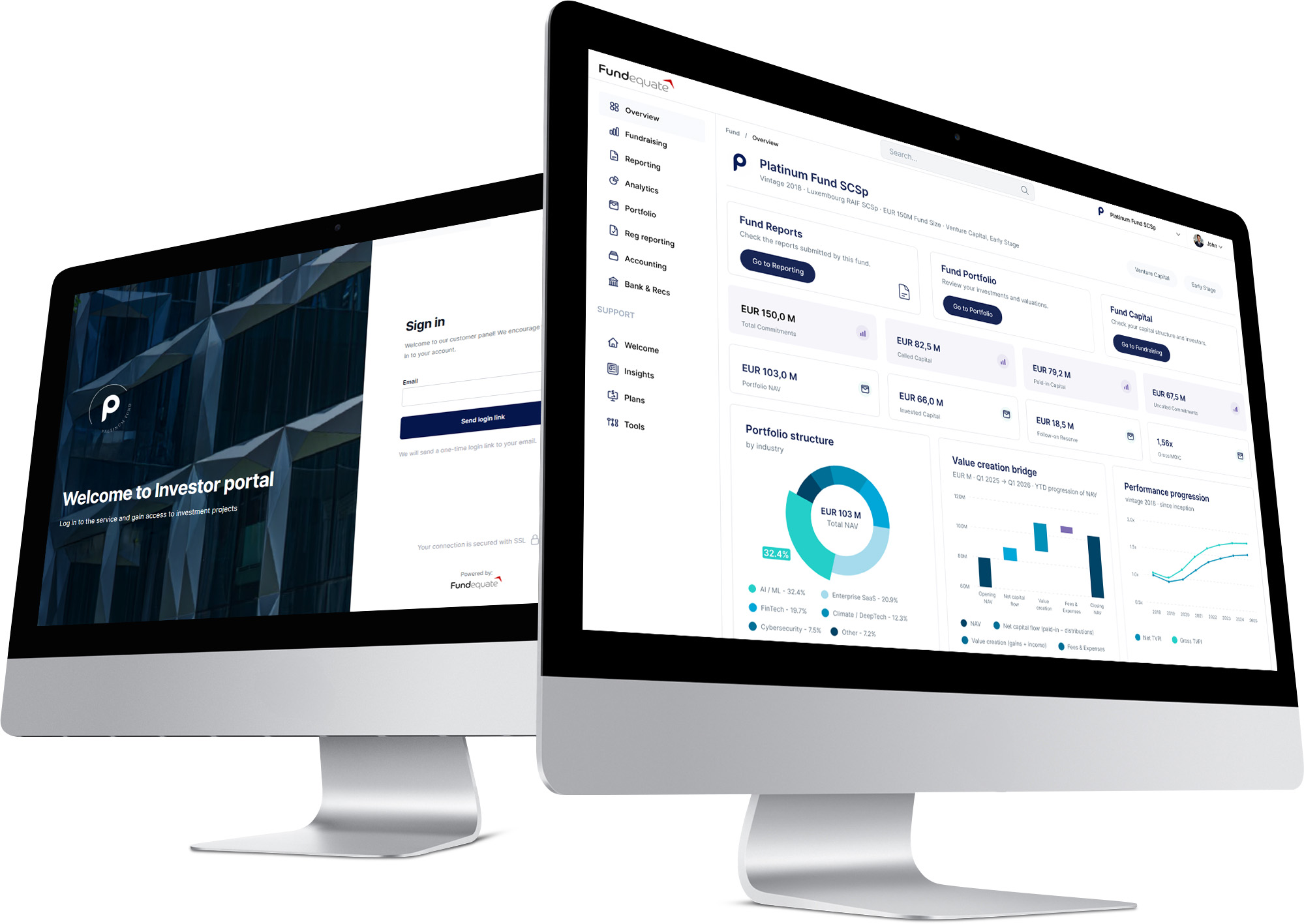
Investor onboarding, commitments and closings, capital calls, distributions, capital accounts and waterfall — with an LP portal, full audit trail and Invest Europe-aligned reporting.
Incorporation, RCS and RBE registration, bookkeeping, statutory accounts, VAT and annual filings, registered office and Luxembourg-resident management — the full substance layer for your fund vehicle.

Fundequate Sàrl is a company registered and domiciled in Luxembourg. We provide innovative solutions to simplify fund structuring, administration, and investor onboarding, ensuring compliance, transparency, and efficiency for fund managers and investors.


Fundequate Sarl
2 Rue Siggy vu Letzebuerg
L-1933 Luxembourg
contact@fundequate.com
Tel. +352 661 324 404
