

A syndicate lead finds the deal and brings the investors; the vehicle, the manager and the books are run by others. In a typical hosted Luxembourg syndicate:
A vehicle pooling passive investors' capital for a defined start-up investment will usually be an AIF, even with a single asset; the test is explained in Is a Luxembourg SPV an AIF? and the vehicle itself in our SCSp guide. The title "syndicate lead" carries no regulatory status of its own: what the lead actually does, sourcing, recommending, deciding or placing, determines which rules apply. The lead develops the deal and the relationships; regulated activities run through the appropriate legal framework.
The process starts with the company, not the SPV. Before anything is set up, the lead confirms a genuine allocation and that the company will accept investment through the proposed vehicle, covering the amount, pre- or post-money valuation, the security, the round's closing date, the rights attached (information, transfer, pro rata, board or observer seat) and the conditions to funding. The lead also checks who signs the subscription or purchase agreement for the SPV and what identification, tax or regulatory information the company will require from it.
The memo is the basis for the manager's review and, within the marketing rules, for investor communication: business model, thesis, market, team, terms, main risks and exit scenarios. It also discloses the lead's own interests:
A good memo is a record of the rationale, assumptions and conflicts known at the time of the decision, not a pitch deck.
Deliverable: an agreed allocation, sufficiently developed terms and a deal memo ready for review by the manager.
Three numbers are set before any subscription becomes binding: the lead's carried interest and its waterfall, the vehicle's costs and how they are funded, and the resulting investment ratio, the share of contributed capital that reaches the company.
| Item | Amount |
|---|---|
| Capital contributed by investors | EUR 800,000 |
| Set-up and running-cost budget | EUR 20,000 |
| Amount invested in the start-up | EUR 780,000 |
| Investment ratio | 97.5% |
The example assumes all costs are funded from contributions and no further cash is retained. A syndicate that raises EUR 800,000 and invests EUR 780,000 says so in its term sheet. Carry rates, fees and the lead's regulatory position are covered in depth in our deal-by-deal SPV guide; the point here is sequencing: economics agreed, then documents, then investors.
Deliverable: commitments, costs, carry, funding and distributions agreed and reflected identically in the LPA and the investor documents.
For a repeat lead on a hosted platform, the GP and the registered AIFM already exist, so opening a deal SCSp means signing its LPA, filing the extract with the RCS and the beneficial owners with the RBE, documenting the AIF classification and management arrangements, and preparing the subscription process and the bank account. The SCSp exists from the signature of its LPA; the filings follow.
Two manager-level points shape the lead's calendar. The registered AIFM tests its thresholds, EUR 100 million including assets acquired through leverage, or EUR 500 million where the AIF portfolios are unleveraged and grant no redemption rights exercisable during five years following the date of initial investment in each AIF, on the aggregate of all the vehicles it manages, so each new deal uses shared headroom. And it notifies each additional AIF to the CSSF under Circular CSSF 25/894 within ten working days of starting to manage it, and provides the corresponding updated AIFM registration information to the CSSF; that is a notification by the manager, not an authorisation of the SCSp. Where a syndicate is launched at the initiative of a third-party sponsor, the parties also assess the applicable white-label requirements, conflicts of interest and allocation of management responsibilities under the current Luxembourg framework.
Banking preparation starts as soon as the GP, the beneficial-ownership structure and the purpose of the transaction are documented. The bank runs its own onboarding of the SCSp, the GP and the ownership chain; signatories, payment authorities and the investor funding procedure are agreed with it. Account opening runs in parallel with legal formation, but the vehicle cannot call capital or fund the investment until the payment arrangements operate. An established GP and banking relationship can facilitate the onboarding of a new SCSp, but the bank may still require vehicle-specific documentation, beneficial-ownership checks and approval of the proposed payment flows.
| Milestone | What it means | What it depends on |
|---|---|---|
| Legal formation | LPA signed; RCS and RBE filings follow | Agreed terms; an existing GP |
| Investor-ready | Documents final, manager in place, onboarding and eligibility checks open | AIF classification; invitation plan |
| Funded closing | Investors accepted, capital received, investment paid | Investor onboarding, bank readiness, the company's closing conditions |
For a syndicate, the LPA clauses that matter most later are those on follow-on financing and on investors who do not fund it (step 8).
Deliverable: a constituted vehicle, statutory filings completed or scheduled, management arrangements documented and onboarding open.
The key decision is not how many investors to invite but which investors may lawfully receive the invitation. The answer depends on the vehicle's regime, the manager's status, the investor's category and the investor's country, and is assessed for each deal rather than assumed. For a Luxembourg AIF not authorised by the CSSF, the CSSF addresses marketing in Luxembourg to professional investors; an individual is not a professional investor because they are wealthy or experienced in start-ups, though MiFID II allows eligible clients to request professional treatment under prescribed tests. A registered AIFM has no marketing passport, so an investor in France, Germany or Belgium is assessed under that country's national rules, where a private placement route exists, before subscription-ready documents are sent. Investor communications may be coordinated by the AIFM or an appropriately authorised intermediary. Any outreach by the syndicate lead is assessed separately, to distinguish permitted introductions from regulated marketing, placement or investment advice; AIFM oversight does not, by itself, exempt the lead from applicable licensing requirements. The roles of the AIFM, any distributor, the GP and the lead are documented. The rules are set out in Who Can You Invite to a Luxembourg SPV? and Pre-marketing and distribution rules for Luxembourg AIFs.
A lead running several syndicates keeps one record per deal:
| Control | Information retained |
|---|---|
| Investor jurisdiction | Residence or registered office relevant to the marketing analysis |
| Investor category | Classification and supporting evidence |
| Legal basis for contact | The applicable marketing permission or other documented basis |
| Communication channel | Responsible person and approved materials |
| Subscription access | Date and conditions on which documents were released |
| Compliance decision | Cleared, restricted or rejected |
Eligibility for one deal does not carry over automatically to the next, and an investor's participation in one syndicate does not establish reverse solicitation for another.
Deliverable: an approved invitation list with a documented legal basis per jurisdiction and investor category.
The investor package combines a contract, compliance and tax: the subscription agreement or LPA accession; eligibility representations; identity, corporate and beneficial-ownership documents; AML/KYC screening and source of funds where required; FATCA and CRS self-certifications; tax representations; data-protection information. The onboarding file is described in Investor onboarding for a Luxembourg fund.
A syndicate can hold an attractive allocation and still miss the round because a few investors are not cleared: missing identification, holding-company chains, incomplete beneficial-owner data, unresolved eligibility, payment details that do not match the investor record. A EUR 10,000 ticket raises the same questions as a EUR 250,000 one; the depth of review may vary with risk, but small tickets are not exempt. That is why a syndicate with many investors needs a structured process rather than email attachments.
A dashboard showing EUR 1 million of interest is not EUR 1 million committed or paid in, and indications of interest are no way around the marketing rules.
Deliverable: approved investor records, accepted subscription documents and a reconciled commitment register.
Using the allocation of step 2, the closing reconciles as follows:
| Stage | Amount |
|---|---|
| Accepted commitments | EUR 800,000 |
| Capital called | EUR 800,000 |
| Contributions received | EUR 800,000 |
| Investment funded | EUR 780,000 |
| Budgeted SPV costs | EUR 20,000 |
Each payment is matched to an accepted commitment and booked to the investor's capital account; the outgoing investment is approved by the GP's signatories under the payment controls. The closing is ready when:
Deliverable: a funded investment, a complete closing file and updated capital accounts.
Between closing and exit there are often several years, during which investors expect news about the company, its valuation, new financing and the position of their SPV. The lead is usually closest to the company. Where the lead sits on its board, confidentiality towards the company and fair information to investors are reconciled in the reporting policy: the lead passes relevant information to the parties responsible for the vehicle's monitoring and reporting and does not promise that everything received from the company can be shared with every investor.
| Report | Typical content |
|---|---|
| Investment update | Major company developments and financing events |
| Capital account statement | Commitment, paid-in capital, distributions and investor position |
| Financial statements | Assets, liabilities, expenses and result under the applicable framework |
| Valuation | Carrying value and assumptions, consistent with the IPEV Valuation Guidelines |
| Capital call notice | Amount, purpose, payment details and deadline |
| Distribution notice | Cash paid, returned capital, profit and carry |
| Tax information | Investor-level data for each partner's own filings |
The Invest Europe Investor Reporting Guidelines are the usual reference (see portfolio reporting in VC and PE funds). A higher valuation is not a realised gain and not distributable cash.
Deliverable: a monitoring routine, current books and capital accounts, and a reporting calendar.
A company that raised its seed round with the syndicate will often invite it into its Series A. Whether the SPV can follow depends on its documents:
Not every investor will fund a follow-on. The LPA settles beforehand what happens to non-participants: dilution or different rights, allocation of pro rata entitlements, admission of new investors, the effect on carry, valuation between rounds and conflicts where the lead invests through several vehicles. A follow-on is a new investment decision, not an informal extension of the first.
Deliverable: approved follow-on terms, a documented financing route and reconciled allocations.
Liquidity can come from a sale of the company, a secondary sale of the SPV's shares, a merger, an IPO followed by permitted sales or in-kind distribution, a partial sale, or a write-off. The company's exit terms decide what the SPV receives; the LPA decides how it is shared, typically return of contributed capital, then any preferred return and catch-up, then the agreed profit split. Partial exits need care, because carry paid on an early gain can exceed the carry earned over the whole investment; escrow, clawback or a cumulative calculation addresses that.
Before paying out, the administrator reconciles proceeds received, transaction costs and liabilities, reserves, return of capital, profit to investors, carry, any escrow, and the cash paid to each investor, and the GP approves the distribution under the documents. Cash, capital-account movements and tax allocations are tracked separately, because they need not coincide. Once the investment is fully realised and obligations settled, the SPV is liquidated and removed from the RCS and the RBE, with the final accounts, tax matters and the manager's notification of the end of management handled along the way.
Deliverable: an approved distribution calculation, reconciled payments and a complete closing record for the vehicle.
A syndicate lead wants to spend time on deals, founders and co-investors, not on building an administrative organisation for every investment. Fundequate brings three things together for SCSp syndicates:
For a lead running ten or twenty SPVs, that separation of records combined with one operating platform is what keeps costs, reconciliations and investor confidence under control.
Run your next Luxembourg angel syndicate on established infrastructure.
An existing GP and registered AIFM, Luxembourg accounting and a digital investor portal, without building separate operations for every deal. See Fundequate for syndicate leads.
A group of investors who invest together in a start-up, coordinated by a lead investor, usually through one vehicle such as a Luxembourg SCSp that holds the shares for all of them.
An angel network primarily connects investors with investment opportunities. An angel syndicate coordinates investors around a particular deal, often through a single SPV led by a lead investor. A network may also organise syndicated investments of its own.
Secure a deal allocation, agree the lead's economics, set up or use an SPV under an appropriate manager, invite only eligible investors, onboard them, call the capital and close the investment. A hosted platform provides the GP, manager and administration.
Sources the deal, negotiates terms, introduces co-investors and follows the company after closing. Investment decisions, marketing and investor admission run through the manager and the appropriate legal framework.
Usually, yes. A vehicle pooling passive investors' capital under a defined investment policy is typically an AIF, even with one start-up, and an AIF needs a registered or authorised AIFM.
Only investors the vehicle may lawfully be offered to. For a Luxembourg AIF not authorised by the CSSF, that is in principle professional investors in Luxembourg, and other countries apply their own rules.
After their subscription is accepted, when the capital call is issued. Payments go to the SPV's account, are matched to each commitment and booked to the investor's capital account.
The SPV receives the proceeds, settles costs and liabilities, runs the LPA waterfall and pays investors and carry. It is liquidated and removed from the registers once all positions are realised; escrows, earn-outs or remaining shares can keep it running after the first distribution.
Costs depend on the structure and the number of investors: documentation, GP and AIFM, investor onboarding, banking, accounting, reporting and the eventual wind-up. They are either deducted from commitments or charged in addition to them; either way, the term sheet should show the costs and the share of each commitment actually invested.
On a platform with an existing GP and AIFM, the SCSp can be formed within days once its documents are ready. Offering the investment and admitting investors follow the eligibility checks and onboarding, and the funded closing depends on bank readiness and the company's own closing timetable.
Fundequate Platform implements six record-design rules for Luxembourg AIFs: one investor identifier, dated events, preserved calculations, notice-level reconciliation, four-eyes approval and LPA-controlled configuration.
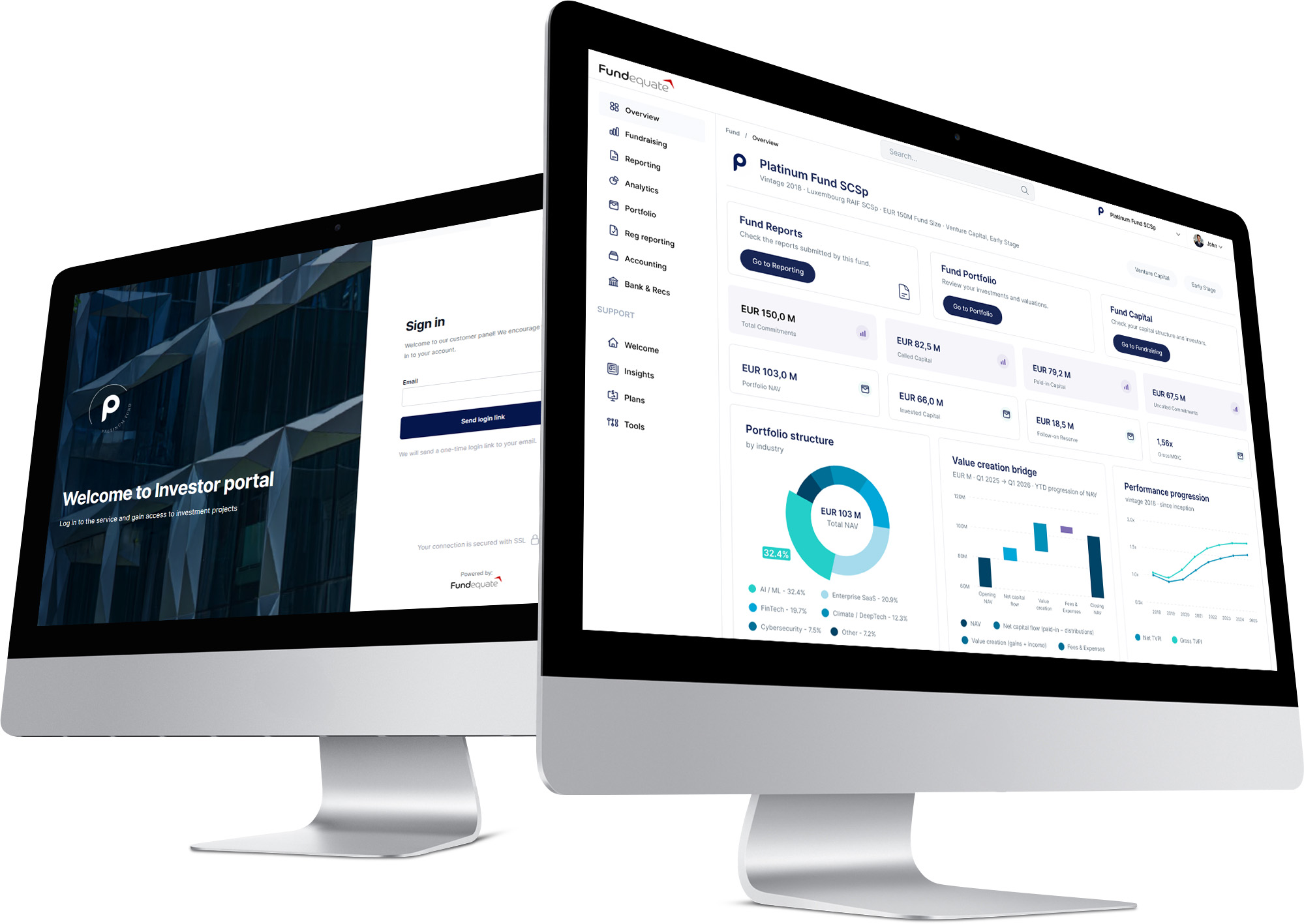
Investor onboarding, commitments and closings, capital calls, distributions, capital accounts and waterfall — with an LP portal, full audit trail and Invest Europe-aligned reporting.
Incorporation, RCS and RBE registration, bookkeeping, statutory accounts, VAT and annual filings, registered office and Luxembourg-resident management — the full substance layer for your fund vehicle.

Fundequate Sàrl is a company registered and domiciled in Luxembourg. We provide innovative solutions to simplify fund structuring, administration, and investor onboarding, ensuring compliance, transparency, and efficiency for fund managers and investors.


Fundequate Sarl
2 Rue Siggy vu Letzebuerg
L-1933 Luxembourg
contact@fundequate.com
Tel. +352 661 324 404
