

The SCSp is governed by Articles 320-1 and following of the Law of 10 August 1915 on commercial companies, introduced in 2013 alongside the reform of the common limited partnership (SCS). The statutory core is short:
Almost everything else is contract. The difference matters for drafting, because the law sets only a handful of rules that the LPA cannot override:
| Point | Fixed by law | Left to the LPA |
|---|---|---|
| Partners | At least one general and one limited partner | Classes of interests, sponsor and carry partners |
| Management | Managed by one or more managers (gérants), who need not be partners; limited partners may not perform external management acts | Who is manager, powers, removal, delegation, investment committee |
| Limited partner rights | A statutory list of acts that do not count as management, such as voting, advising, supervision and loans | Consent matters, advisory committee, information rights |
| Partnership interests | Unless the LPA provides otherwise, a transfer of a limited partner's interest requires the general partner's approval | Securities or capital accounts, transfer and pre-emption rules, pledges |
| Reserved decisions | Changes to the object, nationality or legal form, and dissolution, go to the partners | Majorities, quorum, written resolutions |
| Accounts | An ordinary SCSp keeps appropriate accounting records but is generally not required to prepare and file statutory annual accounts with the RCS; annual reports, financial statements or audit can still arise under the AIFMD, a fund regime or the LPA | Accounting framework (Lux GAAP, IFRS), audit, reporting calendar |
Why the form is used for funds, SPVs, feeders and carry vehicles is covered in our SCSp guide; how it compares with the SCA is in SCSp vs SCA.
The SCSp is a legal form, not a fund regime. It can be used on its own, as an unregulated vehicle, or as the legal form of a RAIF, a SIF or a SICAR. Each product law adds its own requirements: a RAIF must be managed by an authorised AIFM whatever its size, and while it may be constituted by a privately executed LPA, its establishment must then be recorded by a Luxembourg notary within five working days, in addition to the RAIF registration and publication formalities; SIFs and SICARs need prior CSSF authorisation. Most SPVs, syndicates, club deals and emerging-manager funds use the unregulated SCSp; the product options are compared in Alternative investment fund types and structures in Luxembourg.
Whether the SCSp is an alternative investment fund depends on what it does, not on its form: raising capital from a number of investors to invest under a defined policy for their benefit, under Article 1(39) of the Law of 12 July 2013 (the AIF test explained). If it is an AIF, it needs an external AIFM, because an SCSp cannot be internally managed. Per the CSSF FAQ on the AIFM Law, that external AIFM can be the general partner, the manager or an AIFM appointed by the manager, and the registration or authorisation is made in the name of that entity. Depending on the aggregate assets it manages and the fund regime, the AIFM is either registered under Article 3, below EUR 100 million including leverage or EUR 500 million for unleveraged AIFs without redemption rights for five years, both tested across all AIFs it manages, or fully authorised. A registered AIFM does not benefit from the AIFMD marketing passport, and regimes such as the RAIF require an authorised AIFM. Appointing an AIFM separate from the GP does not remove the need to allocate portfolio and risk management to it in substance.
The general partner carries unlimited liability, so in practice it is a capital company, usually a Luxembourg Sàrl, rather than an individual. A sponsor can incorporate its own GP or use an existing one that acts for several partnerships. Where the GP is a capital company, its partnership interest is generally structured below 5% to avoid the deemed commercial activity rule of Article 14(4) LITL (the 5% GP rule). Staying below the threshold does not by itself exclude municipal business tax if the SCSp carries on an actual commercial activity; the activity, the AIF classification and the overall tax structure are assessed separately. For the same reason, carry and sponsor commitments are commonly held through separate limited partner interests rather than through the GP, a structuring practice rather than a legal requirement.
The SCSp needs a registered office in Luxembourg. Where it is located with a third party, the domiciliation rules of the Law of 31 May 1999 apply: the registered office is provided under a domiciliation agreement by a professional authorised to act as domiciliation agent, such as a bank, a professional of the financial sector, a lawyer or a chartered accountant. The same choice determines where the GP's management meetings take place and where records are kept, which matters for substance and tax residence of the GP (substance and domiciliation).
A new GP Sàrl is incorporated by notarial deed with share capital of at least EUR 12,000, paid into a blocked bank account against a blocking certificate. The notary files the articles with the Trade and Companies Register (RCS), and the GP's beneficial owners are filed with the register of beneficial owners (RBE). Where an existing GP is used, its board resolves to act as general partner of the new partnership and confirms its managers and signatories.
The LPA is the constitution of the SCSp. Beyond the statutory minimum (name, object, the general and limited partners), a usable LPA covers:
The subscription agreement, the term sheet or offering memorandum, and the management agreement with the AIFM are prepared in parallel, so that all documents describe the same economics (fund documentation).
The general partner and at least one limited partner sign the LPA, usually as a private deed. The partnership exists from that signature. In a fund or syndicate, the initial limited partner is often a sponsor entity, and investors are admitted later by subscription or accession, without re-signing the LPA.
An extract of the LPA is filed electronically with the RCS through Luxembourg Business Registers and published in the Recueil électronique des sociétés et associations (RESA), within one month of signature. The extract identifies the SCSp, its object, registered office and duration, the general partner, and the managers with their signing powers. Limited partners are not named and the LPA itself is not filed. Filing gives the SCSp its RCS number, which banks and counterparties ask for.
The SCSp files its beneficial owners with the RBE under the Law of 13 January 2019, within one month of the date on which it knew or should have known of the facts requiring the filing. The analysis looks through the GP and the limited partners to the individuals who ultimately own or control the partnership, including by voting or management rights, not only by percentage; where no individual meets the ownership test, the senior managing officials are registered. The filing is updated whenever the beneficial ownership changes.
The register records each partner, its commitment and its interest, and every transfer. Where interests are not issued as securities, each limited partner has a capital account recording contributions, allocated profits and losses, and distributions. The register is kept by or for the GP, together with the current LPA and the record of transfers, and is the evidence of who the partners are, so it is setup before the first investor is admitted.
The bank onboards the SCSp, the GP and the beneficial-owner chain, usually once the RCS number exists, and agrees signatories and payment controls. Starting the bank file on near-final documents is the most effective way to save time: in practice capital calls can only be collected effectively once the account operates.
The accounting framework chosen in the LPA is implemented before the first capital call: chart of accounts, capital-account method, allocation rules and reporting calendar (accounting and reporting). Investor onboarding, covering identification, beneficial ownership, screening, eligibility and tax self-certification, runs under the vehicle's AML/CFT framework under the Law of 12 November 2004, with tasks and responsibilities documented between the GP, the AIFM and the service providers performing onboarding; an unregulated SCSp that is an AIF generally falls under the AML/CFT supervision of the AED, while its Luxembourg AIFM is supervised by the CSSF (investor onboarding for a Luxembourg fund), and invitations follow the marketing rules (who you can invite).
| Workstream | Documents |
|---|---|
| General partner | Notarial deed and articles of a new GP Sàrl, blocking certificate, RCS and RBE filings; or board resolutions of an existing GP |
| Formation | Signed LPA, RCS extract and RESA publication, domiciliation agreement, register of partners |
| Beneficial ownership | Ownership and control chart, RBE filing |
| Regulatory | AIF classification memo, AIFM management agreement, CSSF notification, AML/CFT procedure |
| Tax | Tax identification, VAT registration where required, FATCA and CRS classification, tax position on the 5% GP rule and reverse hybrids |
| Investors | Term sheet or offering memorandum, subscription or accession agreement, eligibility representations, KYC files, self-certifications |
| Operations | Bank mandate and signatory list, chart of accounts, reporting calendar |
With an existing GP and AIFM, the SCSp itself is formed within days of agreed terms: the LPA is signed and the extract filed. A new GP adds a notarial incorporation with its blocked capital account, and an own AIFM adds a CSSF registration as a sub-threshold AIFM or, above the thresholds, a full authorisation. The date that matters to investors, the funded closing, is then set by investor onboarding, the bank account and, for an SPV, the target company's own timetable. The three milestones, legal formation, investor-ready and transaction-ready, are explained in How to set up a Luxembourg SPV.
Because the SCSp is constituted by private agreement, most of its life happens without a notary and without touching the public file:
| Event | What is required |
|---|---|
| Admitting a new limited partner | Subscription or accession under the LPA, onboarding, entry in the register; RBE update if beneficial ownership changes. Generally no RCS filing, unless information subject to filing changes. |
| Capital calls and distributions | Notices and payments under the LPA, booked to capital accounts. No filing. |
| Transfer of a limited partner's interest | GP approval unless the LPA provides otherwise, notification to the partnership, register update, onboarding of the transferee |
| Amending the LPA | Partner decision with the statutory rules and majorities set in the LPA. Changes to information or events subject to mandatory RCS filing or publication are notified to the register; amendments dealing only with internal economics or governance do not necessarily require a public filing |
| Change of GP, manager, name, object, office or duration | Partner or GP decision as the LPA provides, and a filing to update the RCS extract |
| Dissolution and liquidation | Partner decision, liquidation under the LPA, final distributions and deregistration from the RCS, which also removes the RBE entry |
This is the practical advantage of the form for vehicles with many investors: the investor base changes, capital moves and the public file stays the same.
Fundequate sets up and operates SCSp vehicles in Luxembourg: structuring and incorporation, LPA and investor documents coordinated with Luxembourg counsel, domiciliation, and an existing general partner and registered AIFM where the structure qualifies. After formation, a Luxembourg expert-comptable team keeps the books and capital accounts, and the platform runs investor onboarding, commitments, capital calls, distributions and reporting, with sponsors and investors accessing their data online through the investor portal. For syndicate leads the deal-by-deal process is described in the angel syndicate playbook; for fund managers in How to set up an unregulated VC fund.
Setting up an SCSp for a fund, a deal or a carry vehicle?
Use an established GP, registered AIFM, accounting and investor platform instead of building each piece for every vehicle. See syndicates and SPVs or alternative fund managers.
With an existing general partner and AIFM, the SCSp can be formed within days of agreed terms. A new GP Sàrl needs a notarial incorporation first, and the funded closing then depends on investor onboarding and the bank account.
There is no minimum capital and no notary for the SCSp itself. Costs come from the LPA and investor documents, the general partner, the AIFM where the SCSp is an AIF, domiciliation, RCS and RBE filings, the bank, onboarding and annual accounting and reporting.
None. Contributions can be in cash, in kind or in services and are valued by the partners. A general partner incorporated as a Sàrl has its own minimum capital of EUR 12,000.
At least two: one general partner with unlimited liability and one limited partner. Further limited partners are admitted under the LPA without amending the public extract.
Any individual or company, but in practice a capital company, usually a Luxembourg Sàrl, so that unlimited liability is ring-fenced. Its interest is generally kept below 5% to avoid the deemed commercial activity rule of Article 14(4) LITL, which does not by itself exclude municipal business tax on an actual commercial activity.
Yes. There is no nationality or residence requirement for the partners. The SCSp needs a registered office in Luxembourg, usually through a domiciliation agent, and its general partner, managers and AIFM are chosen with substance and regulation in mind.
Only if it is an AIF, which depends on its activity. If it is, it needs an external AIFM, because an SCSp cannot be internally managed; the general partner itself can take that role if it holds the status. The AIFM is registered or authorised depending on its aggregate assets and the fund regime; a RAIF always needs an authorised AIFM.
An unregulated SCSp has no statutory obligation to prepare or publish annual accounts. It keeps accounting records under the framework set in the LPA, and tax filings, investor reporting or a product regime may still require financial statements.
Under the LPA: subscription or accession, onboarding and an entry in the register of partners, with an RBE update if beneficial ownership changes. No notary and no RCS filing are needed for a new limited partner.
Fundequate Platform implements six record-design rules for Luxembourg AIFs: one investor identifier, dated events, preserved calculations, notice-level reconciliation, four-eyes approval and LPA-controlled configuration.
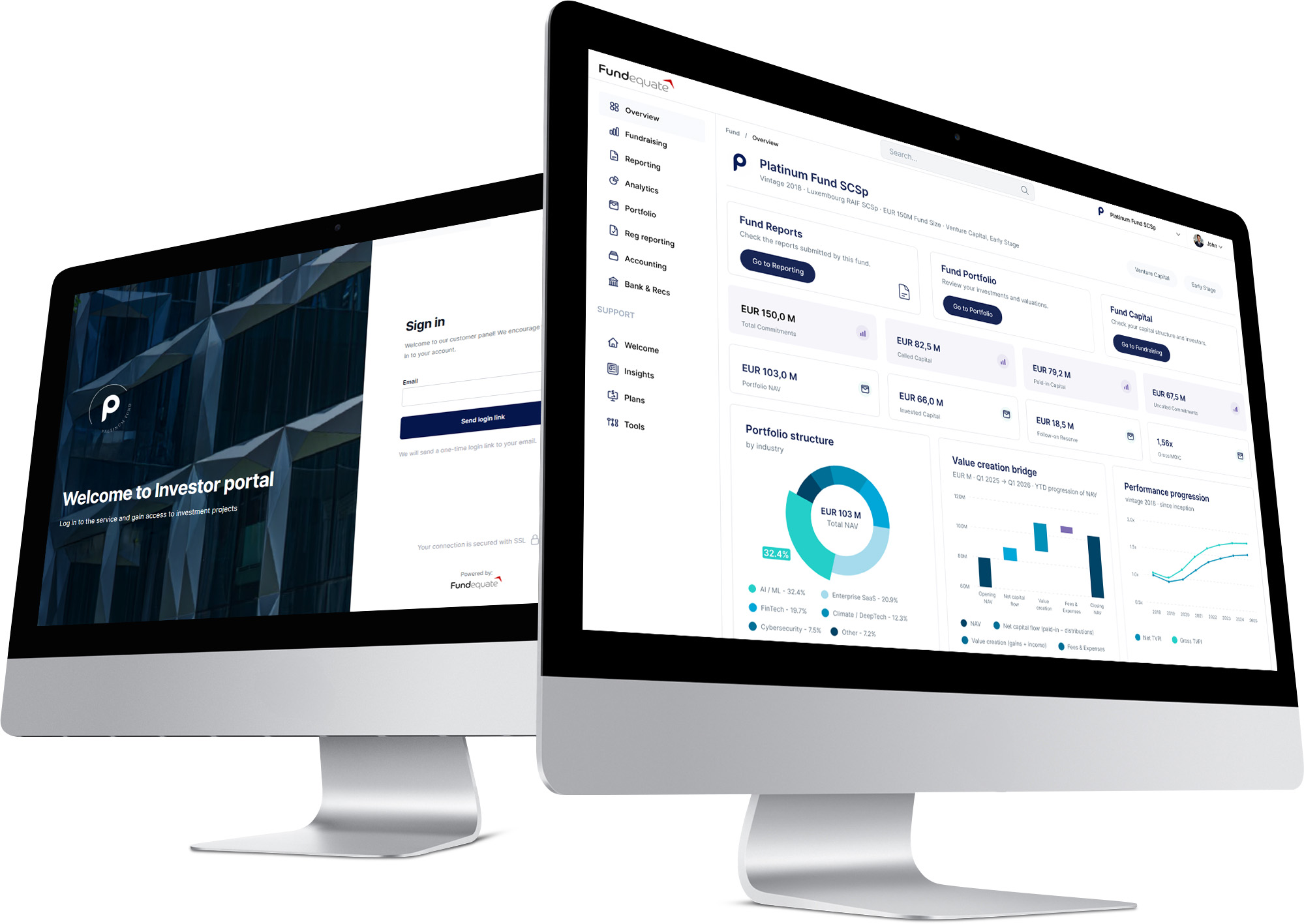
Investor onboarding, commitments and closings, capital calls, distributions, capital accounts and waterfall — with an LP portal, full audit trail and Invest Europe-aligned reporting.
Incorporation, RCS and RBE registration, bookkeeping, statutory accounts, VAT and annual filings, registered office and Luxembourg-resident management — the full substance layer for your fund vehicle.

Fundequate Sàrl is a company registered and domiciled in Luxembourg. We provide innovative solutions to simplify fund structuring, administration, and investor onboarding, ensuring compliance, transparency, and efficiency for fund managers and investors.


Fundequate Sarl
2 Rue Siggy vu Letzebuerg
L-1933 Luxembourg
contact@fundequate.com
Tel. +352 661 324 404
